


How to Calculate the Load Capacity You Need in a Pallet Truck
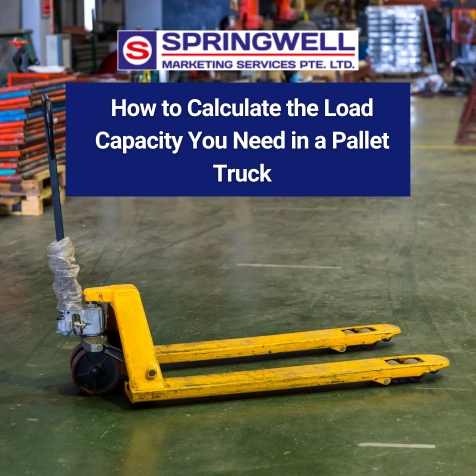
When choosing a pallet truck (also known as a pallet jack), one of the most important — yet often overlooked — factors is load capacity. Selecting a model with the right load rating not only ensures safety and efficiency but also helps prolong the lifespan of your equipment.
Whether you operate a warehouse, logistics centre, or retail storeroom, understanding how to calculate the correct pallet truck load capacity can prevent costly breakdowns, accidents, and product damage.
Here’s a clear guide to help you get it right.
What “Load Capacity” Means in a Pallet Truck
Load capacity refers to the maximum weight a pallet truck can safely lift and transport. It’s usually measured in kilograms (kg) or tonnes (T).
For example, a standard hand pallet truck might have a rated capacity of 2,500 kg (2.5T) — meaning it can safely handle loads up to that weight under ideal conditions.
However, real-world use isn’t always ideal. Factors like uneven weight distribution, pallet size, and load centre can affect how much weight the truck can actually handle safely.
Why Choosing the Right Capacity Matters
Selecting a pallet truck with insufficient capacity can lead to:
- Equipment strain or failure, especially in hydraulic or wheel components
- Load instability, which increases the risk of tipping or dropping goods
- Workplace accidents, endangering operators and nearby staff
- Higher maintenance costs from premature wear
On the other hand, over-specifying (choosing a truck with much higher capacity than needed) may increase cost unnecessarily and reduce manoeuvrability due to heavier build.
The goal is to match the pallet truck’s capacity to your operational load range — with a small safety buffer built in.
Step-by-Step: How to Calculate the Load Capacity You Need
To find the right capacity, you’ll need to assess three key factors:
- Weight of your typical load
- Load centre distance
- Type of pallet and load distribution
Let’s break each one down.
1. Determine the Average and Maximum Load Weight
Start by identifying the heaviest pallet or load you handle on a regular basis. This should include:
- The total weight of goods
- The weight of the pallet itself (usually 20–30 kg for wooden pallets)
For instance, if your heaviest load is 1,800 kg and you use standard pallets, you should consider a 2,000–2,500 kg capacity pallet truck for safe operation.
Tip: Always plan for your maximum expected load, not just your average. It’s better to have a small safety margin than to risk overloading.
2. Understand Load Centre Distance
The load centre is the horizontal distance between the load’s centre of gravity and the front face of the forks.
For standard 1,200 mm pallets, the load centre is typically 600 mm (half the pallet length).
If your load extends beyond the standard size or is unevenly distributed, the effective load centre shifts forward — which reduces the truck’s safe lifting capacity.
In other words:
The farther the load’s centre of gravity is from the forks, the less stable and effective the lifting capacity becomes.
For long or irregular loads, always consult your pallet truck’s load chart (available from the manufacturer or supplier) to confirm the safe working capacity.
3. Evaluate Pallet Type and Load Distribution
Not all pallets are equal. Some are block pallets, others stringer pallets, and they vary in structural strength. Additionally, your goods might be evenly spread or concentrated on one side.
Uneven or fragile loads can create point pressure on the forks, potentially damaging the pallet or reducing stability.
A pallet truck rated for 2,500 kg assumes the load is evenly distributed. If loads are top-heavy, unstable, or off-centre, you may need to downgrade the effective capacity by 10–20% or choose a heavy-duty model with reinforced forks.
Example: Calculating a Safe Load Capacity
Let’s say your warehouse handles pallets of building materials that weigh 2,200 kg each.
- Each pallet measures 1,200 mm x 1,000 mm
- Load centre = 600 mm
- Load is evenly distributed
In this case, a 2,500 kg hand pallet truck would be ideal. It provides a safety buffer of about 300 kg, preventing strain on hydraulic seals and wheels.
If your loads occasionally reach 2,700 kg or are unevenly stacked, consider upgrading to a 3,000 kg capacity model for extra durability.
Other Factors That Affect Load Capacity
Fork Length
Longer forks can support larger pallets but may slightly reduce manoeuvrability in tight aisles. Always ensure the forks fully support the pallet base.
Floor Conditions
Rough or uneven floors increase rolling resistance and strain. If your facility has such conditions, a heavy-duty or powered pallet truck may perform better.
Operator Technique
Improper lifting angles or sudden turns can shift weight unexpectedly. Operator training is just as crucial as choosing the right truck.
Type of Pallet Truck
- Manual Pallet Truck – Ideal for short-distance, moderate loads (up to 2.5–3.0T).
- Electric Pallet Truck – Handles heavier or more frequent loads with minimal effort.
- High-Lift or Weighing Pallet Truck – Offers ergonomic lifting or built-in weight measurement.
How to Maintain Optimal Performance
Even the best pallet truck can lose performance if not maintained properly. To ensure long-term reliability:
- Inspect wheels and bearings regularly for wear.
- Keep hydraulic oil at recommended levels.
- Avoid exceeding rated load capacity.
- Store the truck indoors, away from moisture.
Regular maintenance not only extends lifespan but also ensures continued safety and compliance.
Choosing the Right Pallet Truck for Your Business
At Springwell, we understand that every warehouse and logistics operation has unique load-handling needs. Our wide range of manual, semi-electric, and fully electric pallet trucks are built to meet Singapore’s demanding industrial standards.
Whether you require a light-duty pallet jack for retail use or a heavy-duty model for manufacturing and logistics, our team can help you calculate the precise load capacity and specifications suited to your workflow.
Takeaway
Calculating the correct pallet truck load capacity isn’t just a matter of numbers — it’s a key part of safe and efficient material handling. By understanding your load weight, centre of gravity, and distribution, you can make smarter equipment choices that protect your staff, goods, and investment.
If you’re unsure which model fits your operation, Springwell’s experts are here to help.
Contact Springwell for the right pallet truck in Singapore — built for safety, performance, and lasting reliability.