


How do Work Positioners Function?
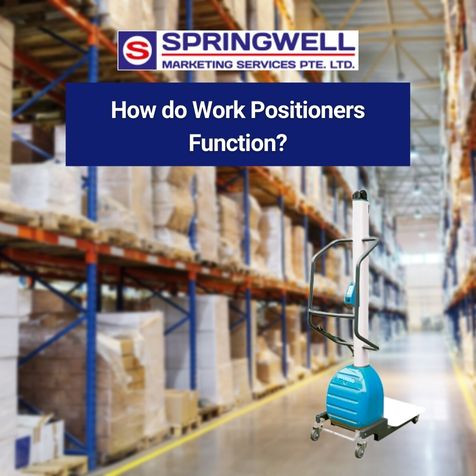
Work positioners are an invaluable resource for improving safety, efficiency, and accuracy in the workplace. By utilising these tools, workers can move items with a greater degree of precision and speed – allowing them to complete tasks more quickly and precisely than ever before.
Understanding Work Positioners
Work positioners are machines that efficiently transport materials from one area of a workspace to another.
The system features a platform, usually fitted with rollers or conveyors. Its platform is capable of positioning and shifting in three dimensions (X, Y, Z) to slide, rotate or move objects with precision and accuracy. Work positioners are also designed with adjustable arms and tilt to easily access hard-to-get areas, as well as adjust the weight’s centre of gravity.
Positioners are essential to industrial production operations due to their speed and dependability. To ensure the safety of operators when using them, various models include brakes and speed controls in addition to other protective features.
When combined with the right training for people who use them, work positioners can be a powerful tool that adds efficiency while keeping risks at a minimum.
Functionality of Work Positioners
Work positioners are ideal for managing hefty components or materials that necessitate precise positioning, and any other repetitive tasks such as welding or grinding. Most models can lift up to 10,000 pounds while offering an array of movement options with adjustable speeds as well as manual overrides if needed.
As previously mentioned, the motorized components of a work positioner can be used to move and rotate materials and parts in three dimensions. This provides precise positioning along the production line, including loading and unloading functions.
Not only can work positioners be used for loading and unloading, but they are also incredibly useful when it comes to assembling, inspecting, and even rotating products during the packaging process.
Types of Work Positioners
The right type of work positioners depends on the specific application and the weight, size, and shape of the components that need to be moved.
Rotary work positioners allow parts to be manipulable in any direction, while linear models utilise slides that can move components with pinpoint accuracy. The table type is yet another model of a work positioner which permits up-and-down motions and may also include rotational capabilities.
For industries such as aerospace and automotive manufacturing where accuracy is critical, advanced features like software-controlled operations are often employed with sophisticated work positioners.
This enables faster cycle times while also improving precision by allowing a higher degree of repeatability. Such advanced positioners can also be integrated with robotics and other automated systems to facilitate greater efficiency.
Benefits of Work Positioner
Utilising a work positioner offers an array of advantages. Here are just some of the many benefits that it has to offer:
- reduces fatigue and the risk of injury due to repetitive manual motions
- saves production time
- simplifies the product assembly process
- customisable according to specific needs and requirements in different industries
- provides a more consistent workflow by allowing operators to stay in the same position for multiple tasks
Safety Measures When Operating Work Positioners
To ensure the safety of all operators, all guards and shields must be properly installed on a work positioner before use. Additionally, operators should be adequately trained to safely operate the device with proficiency.
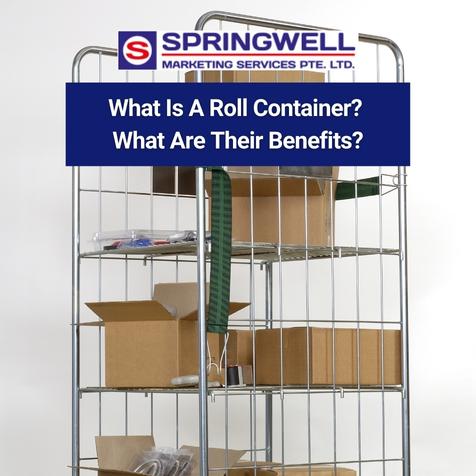
Contrary to what you may think, roll containers aren’t round, they have a square base with rectangular sides. Roll containers get their name from it being a cage on wheels that you can roll around a warehouse to transport items.
Roll containers are commonly used in warehouses, factories, and retail stores as they are an effective way to move and store items quickly and efficiently.
Types of Roll Containers:
Open-Top Containers: Open-top containers are designed to transport items that can’t fit in a standard enclosed container. They do not have lids or doors and provide easy access to the contents inside.
This type of container is often used to move bulky items like furniture, large pieces of machinery, and vehicle parts. It is also perfect for moving perishables such as fruits, vegetables, and plants.
Flat Rack Containers: Flat rack containers are designed for larger, heavier items such as heavy machinery and vehicle components. These containers have no sides or doors, but they do feature a removable top and bottom to provide easy access.
Flat racks are generally used when the contents of the container cannot fit in a standard enclosed container due to its size and weight. They can also be used to move contents that are too large to fit in a standard container and must remain outside.
Platform Containers: Platform containers are the most versatile type of container and can be used for a variety of purposes. This type of container has no sides or doors, but it does feature removable top decks and walls that allow easier access to the contents within.
Platform containers are often used to transport large quantities of goods or bulky items such as furniture, arts and crafts, and other large items. Platform containers are also ideal for transporting goods that are too large to fit in a standard enclosed container, but still, need protection from the elements.
Benefits of Using Roll Containers:
Roll containers are very durable. They are made from heavy-duty materials such as aluminium or steel that can withstand a lot of wear and tear. The containers are also cost-effective and widely available.
Roll containers also protect the items within it. Items can be neatly stacked and the doors of the container securely fastened so goods can be stored and moved with peace of mind.
Its uniform shape and size also make it a perfect tool for storage in warehouses as roll containers are space efficient and can be packed tightly next to each other to maximise warehouse storage space.
In summary, roll containers are a great choice for transporting goods. It is a durable and cost-effective method for transporting goods. Additionally, roll containers are versatile enough to be used on trucks, boats, trains, and aircraft. The right container depends on your individual needs but with a wide range of styles available, you will find something perfect for what you need.

Jib cranes are often used in workshops and factories as they are easy to use and help workers safely and efficiently conduct repetitive lifting tasks while reducing workplace injuries.
What Is A Jib Crane?
A jib crane is a type of overhead lifting device commonly used in industrial settings. The crane has an “arm” or “jib” that extends out from the base, allowing them to move materials horizontally and vertically within a limited area.
This makes them ideal for use in small spaces where other types of cranes may not fit. The jib can also be rotated around its base, providing more flexibility when lifting heavier loads. Jib cranes can be mounted on the wall, ceiling, or floor and come in various sizes and models depending on their application.
Functionality Of Jib Cranes
Jib cranes are typically powered by an electric motor, making them highly efficient and safe to operate. It functions with a pulley and cable system to lift loads up and down, while the jib rotates around the base to move materials horizontally. This greatly reduces the amount of manual labour required to move and place materials. The jib crane can be operated with either a manual or remote system, further improving safety and efficiency when handling large amounts of material.
The versatility of the jib crane also makes it ideal for a wide range of applications in various industries such as manufacturing, construction, mining, fishing, agriculture, and shipbuilding. It can be used to lift and move materials into areas that are difficult for humans or machines to access, allowing for greater productivity in a short amount of time.
Types of Jib Cranes:
Freestanding Jib Crane: The most popular type of jib crane as it can be used both indoors and outdoors. It is also the most portable out of all the jib crane options.
It is considered the least expensive type of jib crane, making it a popular choice for businesses that need to keep their budgets low. It’s mainly used for lighter loads and can be assembled quickly, so it’s ideal for tasks that require a quick set-up and tear down.
Wall-Mounted Jib Crane: This crane can be attached to a wall for lifting and moving smaller loads in tight spaces. This type of crane is also very cost-effective, making it great for businesses that don’t have a big budget for machinery.
It’s easy to assemble and can be used both indoors and outdoors. However, note that the crane should only be mounted on a sturdy wall or column to avoid the crane negatively impacting the load-bearing weight of the structure.
Floor-Mounted Jib Crane: A crane mounted directly onto the floor with an adjustable arm and hoisting system that can handle heavier loads compared to a wall-mounted jib crane.
Floor-mounted jib cranes can carry the heaviest loads amongst other types of job cranes, at lengths of up to 9 meters. This higher-capacity crane has the potential to lift 1000 pounds worth of weight. They also have more flexibility given that they can do 360-degree rotations.
Safety Measures When Operating a Jib Crane:
To ensure the safety of all workers operating jib cranes, they should be properly trained before being allowed to operate them. Operators must know the maximum load-carrying weight and the crane’s maximum carrying distance to ensure that loads are within acceptable and safe ranges. Workers should also don the appropriate safety gear when working with jib cranes.
Last, regular inspections and maintenance should be conducted to detect any potential defects and issues with the machine before it is used.
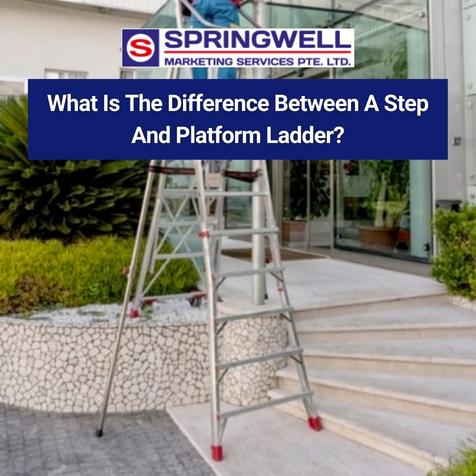
It is a pretty much a given fact that anyone who wants to change a light bulb would always wonder what ladder should they buy, a step or platform ladder. If so, you my friend are not alone.
Many people are unsure of the differences between these two types of ladders, and as a result, they often use the terms interchangeably. However, there are some key distinctions that you should be aware of.
Portability
Step ladders are usually more portable given their smaller size. This makes it generally lighter and you can have it put anywhere in your home as opposed to platform ladders. With step ladders, you can place it in a corner or store it away after use. This makes it easier for a person to decide where to put their ladders at home.
Platform ladders on the other hand are larger which makes portability more difficult. Generally speaking, these type of ladders are mainly used in warehouses.
Stability
Platform ladders are usually more stable since they have a wider base which typically makes it much more difficult for you to fall off and in some cases, suffer injuries because of it. There are also handrails and other safety features that come with platform ladders which can help you maintain your balance while climbing up and down the ladder.
On the other hand, step ladders don’t have these safety features and are not as stable since they are more narrow. But given the fact that it’s smaller in size, you won’t typically fall off in any kind of dangerous manner. However, it’s best to still be extra cautious when using a step ladder so that you don’t put yourself in any potentially risky situations.
Versatility
With platform ladders, chances are you can usually do tasks that require both hands, such as painting the wall, cleaning the windows, or even reaching high shelves or cupboards. The thing with platform ladders is they have essentially more versatility as compared to step ladders. Platform ladders also have the benefit of completing tasks that require the user to move up and down, as they allow for an easier transition between levels.
Step ladders on the other hand would not have that luxury. But given, it is smaller in size, it is completely logical. The thing is, the size of step ladders makes them ideal for tasks that do not require one to move up and down but only a single level, such as changing a lightbulb or simply reaching something on the shelves.
Cost
Step ladders are usually less expensive than their counterpart given their smaller size. The justification for it comes from the fact that step ladders are designed for one person to use at a time and require less material than platform ladders. Step ladders are also typically ideal for people with a limited budget.
Platform ladders on the other hand are a different ballgame where most of the time, are usually more expensive than step ladders.
So, with all that said which would you rather pick? Would you get the larger platform ladder or the step ladder, it is best to say it depends on your individual needs.
Step ladders can be suitable for most projects that require little height, while platform ladders offer a larger working space and are suitable for more industrial type of work.
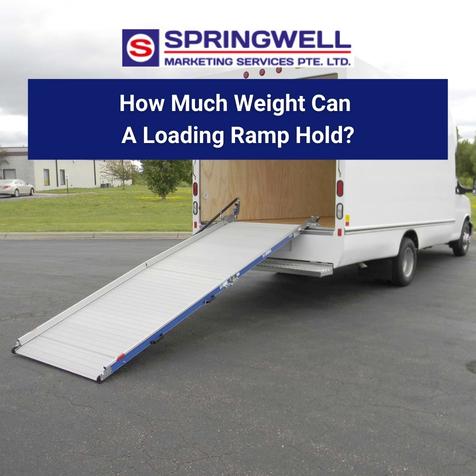
If you are planning on loading a heavy piece of equipment onto a truck or trailer, you would need to know how much weight your loading ramp can hold.
What Is The Average Weight for Loading Ramp?
The average loading ramp can hold is 1,000 to 1,500 pounds. With that out of the way you might imagine that ramps with higher weight capacities will be more expensive and that’s true. Most of the loading ramps in the market can hold up to 1,500 pounds but you should definitely look for larger capacity if you are dealing with heavier loads.
Depending on the model, it’s load capacity can even be up to 23,000 pounds.
When shopping around for the right loading ramp, make sure to consider the size of your load, the type of material it’s made from, the weight capacity of the ramp and how much extra room is needed to mount or deploy it.
Distribute The Weight
It is common practise to distribute the weight of your load to avoid badly damaging the ramp, but how do you actually do that? Here’s what you’ll need to do:
1. Place more support on the center of your load. This will ensure that it doesn’t shift from side to side when being moved.
2. Secure your cargo with straps or chains so that it doesn’t move too much when it is being loaded or unloaded.
3. Make sure the weight of your load is evenly distributed to minimize damage to the ramp itself.
4. When loading a trailer, make sure that the tongue weight does not exceed the rated capacity for your loading ramp. That can be dangerous and cause major damage in the long run.
5. Maintain the ramp by cleaning it regularly, checking for rust or corrosion, and lubricating any moving parts.
6. Inspect your loading ramp before each use to make sure it is in good condition and won’t cause harm or damage during operation.
This here is a general idea for you to know but you get the idea. The fact of the matter is to always maintained your loading ramp and make sure it is in good condition. Not only will this help you stay safe but also give a longer lifespan to your equipment.
Check The Weight Limit Before Use
You should always check the weight limit of the loading ramp before you or your team use it to load and unload heavy goods. This is important because if overloaded, it can cause the structure of your ramp to break and injure someone severely in the process.
Also, never forget to check the loading ramp’s manual before you use it since it contains safety instructions that you should follow to ensure its safe operation.
Here is a list of safety tips for when using your loading ramp:
1. Always make sure that your loading ramp is properly set up and securely attached to your trailer.
2. Make sure that the loading ramp is placed on a flat and even surface.
3. Load and unload slowly, being careful not to exceed the weight capacity of the ramp.
4. Avoid sudden changes in speed or direction when driving over the ramp.
5. Do not use the loading ramp unless it is completely dry.
6. If you need to use the ramp in wet weather, make sure to put down a non-slip material
Depending on how you look at it, it might look too much that you should care about these things but frankly, it is all for your safety. So, it’s better to take precautions than to take chances and end up in an accident.
Our company Springwell also provides ramps and especially vehicle loading ramps which you might be interested in after reading this blog. Please do check on our site for further information or if you have any questions needed to be answered.