


Why Buy a Hand Trolley For Material Handling

There are many different types of hand trolleys available on the market, each with their own unique benefits. If you’re in the market for a new hand trolley, then it’s important to choose one that will best suit your needs. Here are just a few reasons why you might want to buy a hand trolley for material handling:
1. Makes Transporting Bulky Items Easy
One of the biggest advantages of using a hand trolley is that it makes transporting bulky items much easier. If you have to move heavy boxes or other large items regularly, then a hand trolley can make your life much easier.
2. Improved Efficiency
Another reason to use a hand trolley is that it can help to improve your efficiency. If you’re regularly moving heavy items around, then a hand trolley can help you to do so much more quickly and easily.
This means that you’ll be able to get the job done faster and move on to other tasks.
3. Reduced Risk of Injuries
Another big advantage of using a hand trolley is that it can help to reduce the risk of injuries. If you’re regularly lifting heavy items, then there is a risk that you could injure yourself.
However, if you use a hand trolley, then you’ll be able to avoid this. This is because the trolley will do the lifting for you, which means that there is far less chance of you injuring yourself.
4. Improved Safety For Items
Another benefit of using a hand trolley is that it can actually improve the safety of the items that you’re carrying.
If you are carrying heavy or fragile items, then there is always a risk that they could get damaged. However, if you use a hand trolley, then you’ll be able to keep them safe and secure.
5. Hands Free Approach
Finally, you should also know that a hand trolley is a great way to transport items without having to use your hands.
If you need to carry a lot of items, then it can be very difficult to do so if you don’t have a trolley. This is because you’ll have to use your hands, which can be very tiring.
However, if you use a hand trolley, then you’ll be able to transport everything without having to use your hands. This is a great benefit, as you can perform all these tasks with great ease.
6. Convenient
Hand trolleys are incredibly handy. They can be moved from one location to the next with ease. You may also fold them down for convenient storage when they’re not in use, which means you won’t have to worry about taking up too much room in your warehouse or factory.
7. One of The Most Affordable Equipment To Use
Finally, hand trolleys are one of the most affordable pieces of equipment that you can use. They’re very inexpensive, which means you won’t have to break the bank in order to get your hands on one.
If you’re looking for a great way to move heavy objects around your warehouse or factory, then a hand trolley is a great option. They are very affordable, easy to use, and they can be moved from one location to the next with ease. You won’t regret investing in a hand trolley for your business.
8. Can Be Used In Various Ways
Hand trolleys can be used in various ways. You can use them to move heavy objects around your warehouse or factory, or you can use them to transport goods from one location to the next.
There are many different uses for hand trolleys, which makes them a versatile piece of equipment. If you are looking for a way to make your life easier, then a hand trolley is a great option.
Springwell Marketing’s Hand Trolleys
If you are in the market for hand trolleys and hand trucks, then Springwell is the place to go. We offer a wide variety of hand trolleys that are perfect for any business. We have a team of experts that can help you find the right hand trolley for your needs.
Contact us today to learn more about our hand trolleys and how we can help you make your business more efficient.

Every business has to manage their materials wisely, and material handling equipment is key to achieving this goal. Companies use material handling for many things, such as distribution or production.
Depending on the company’s needs, each one will have a different way of using it. Some businesses might need specialised equipment that can’t be bought in stores. That’s when custom solutions come into play.
The Challenge With Pre-Manufactured Equipment
Pre-designed material handling equipment, along with other components such as forklifts and pallet jacks, performs the necessary activities in material handling.
However, it’s the finer aspects that are significant for boosting production efficiency in warehouses and facilities. Even small inefficiencies and difficulties can accumulate over time, especially in these areas.
Weaker ergonomics:
Workers might have to twist or turn their bodies uncomfortably to use the equipment.
Inadequate functionality:
The equipment might not be able to do everything that’s needed, or it might not work well with other types of equipment in the facility.
Difficulty in getting a one size fits all solution:
There might not be a piece of equipment that’s perfect for the task at hand, so workers have to make do with something that’s less than ideal.
The right equipment can make a big difference in terms of productivity and efficiency, so it’s worth taking the time to find the best possible solution for the task at hand.
The Benefit of Getting Custom Material Handling Equipment
Reduced Labour Costs
The use of machines to handle materials can help to reduce the amount of time and labour required to complete a task. This can lead to reduced labour costs and an increase in efficiency.
Improved Productivity
Custom material handling equipment can often be designed to speed up the production process. This can help to improve overall productivity and efficiency.
Improved Safety
Using the right material handling equipment can help to improve safety in the workplace. This is particularly important in industries where there is a risk of injury to workers.
Reduced Damage
Custom material handling equipment can be designed to reduce the amount of damage that occurs to materials during the production process. This can lead to increased profits and improved customer satisfaction.
Improved Quality
Custom material handling equipment can be designed to improve the quality of the final product. This can lead to increased sales and improved customer satisfaction.
Better Integration
Custom equipment can help to improve system integration within warehouses, by complementing existing systems and processes to maximise efficiency.
Control
Custom material handling solutions can be designed to improve quality control throughout the production process. This can lead to increased profits and improved customer satisfaction.
Catered To Your Daily Operational Needs
Overall, custom solutions can be designed to meet the specific needs of your business. This can help to improve efficiency and productivity in your daily operations.
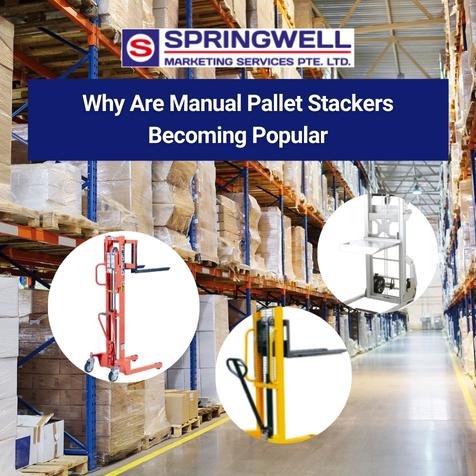
There are many reasons why manual pallet stackers have become popular in recent years. One reason is that they offer a versatile and convenient way to move and store heavy objects. They also eliminate the need for a forklift or other powered lifting device, which can be expensive to maintain and operate.
What Are Manual Stackers For?
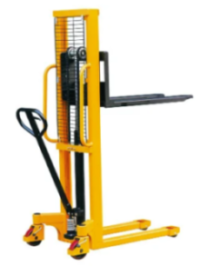
A stacker is an equipment that lifts goods to the appropriate height for storage or to allow block stacking of products or pallets, or in order to move heavier loads and safely place them on a surface such as a warehouse floor.
Cost-effective Option
Manual stackers offer a cost-effective solution for businesses that need to move and store heavy objects on a regular basis. They are typically much less expensive than powered lifting devices such as forklifts, and they require very little maintenance.
Convenient and Versatile
Manual pallet stackers are also very convenient and versatile. They can be used in a variety of settings, including warehouses, factories, and retail stores. They are also easy to operate, and they can be used to lift and move goods of all shapes and sizes.
Very Robust
Another advantage of these stackers is that they are built to be very tough and can handle a lot of weight.
This makes them ideal for businesses that need to move heavy loads on a regular basis. Some models can even lift up to two tons, which is more than enough for most applications.
Safe Option
Manual stackers are also much safer than powered lifting devices such as forklifts. This is because they are not powered by electricity or gasoline, and they do not produce emissions. They are also much less likely to tip over, and they can be used in a variety of settings without posing a risk to nearby pedestrians or workers.
Easy To Use
Manual stackers are also very easy to use. They can be operated by a single person, and they do not require any special training or certification.
Easy To Maintain
They are also very easy to maintain, and they can be used for a long time without needing to be replaced.
Do Not Require Certification
Additionally, they do not require any type of certification or training to use, which makes them a good option for businesses that do not have the budget or resources to invest in more expensive lifting equipment.
However, although there is no certification required to operate a walkie stacker, all operators must learn how to safely control the forklift before use.
Compact Designs
Another advantage of manual stackers is that they have compact designs, which makes them easy to maneuver around tight spaces. This is especially beneficial for businesses that have limited storage space or that need to move lifting equipment between different areas frequently.
Get a Pallet Stacker From Springwell Marketing
Here at Springwell Marketing, we offer a wide variety of stackers in Singapore.
Regardless of whether it is a Manual Pallet Stacker, Semi-electric Pallet Stacker or Full Electric Pallet Stacker, we are able to advise you accordingly.
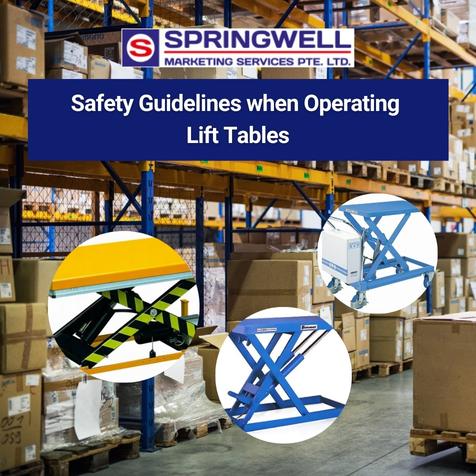
A lift table is a machine that uses a scissors mechanism to raise or lower items and/or people. Lift tables are commonly used to elevate big, hefty loads over short distances. Pallet handling, vehicle loading, and work positioning are examples of popular usages.
When it comes to working with lift tables, safety is always the top priority.
Here are some essential safety guidelines to keep in mind when operating a lift table:
1. Inspect The Equipment
Before using the lift table, it is important to inspect the equipment. Make sure that all safety devices are functioning properly and that there are no loose parts. If you notice any damage, do not use the lift table and contact a qualified technician for repairs.
2. Inspect The Worksite
Inspect the worksite to ensure that it is level and free of debris. Make sure that there is enough clearance for the lift table to operate safely.
3. Read The Manual
Operating a lift table without first reading the manual is dangerous. The manual contains important information about the lift table, such as its weight capacity and how to properly use the controls.
4. Use The Proper Controls
There are two sets of controls on a lift table: the up/down control and the stop button. The up/down control is used to raise and lower the table, while the stop button is used to stop the table in case of an emergency.
5. Don’t Overload The Table
Lift tables have a weight capacity that must not be exceeded. Overloading the table can cause it to tip over, which can lead to serious injury.
6. Keep Your Hands and Feet Clear
When the lift table is in use, make sure to keep your hands and feet clear of the moving parts. Otherwise, you could get caught in the mechanism and seriously injured.
7. Never Leave The Table Unattended
If you need to leave the area while the lift table is in use, be sure to turn it off first. Otherwise, someone else could come along and operate the table without knowing how to do so safely, which could lead to an accident.
8. Use The Table For Its Intended Purpose
Lift tables are not meant for general purpose use. They should only be used for lifting and lowering materials. If you try to use it for something else, such as a makeshift stool, you could damage the table or hurt yourself in the process.
9. Keep The Table Clean
Lift tables need to be kept clean so that they can operate properly. If there is debris or other objects on the table, it could interfere with the mechanism and cause the table to malfunction. Make sure to keep the area around the lift table clear so that nothing can get in the way of its operation.
10. Practise Distancing
It is important to practise social distancing when using a lift table. This means keeping a safe distance from the table and avoiding crowded areas. If you are lifting heavy objects, make sure to ask for help so that you don’t strain yourself.
When the lift table is in use, make sure no one stays near the work area who isn’t involved in the operation. Before it is utilised to prevent any fatalities and/or injuries, they must stand 1 meter away from the handling equipment.
11. Keep Both Feet Planted On Work Platform
When working on a lift table, always keep both feet planted firmly on the work platform. This will help to prevent you from losing your balance and falling off the table. If you need to reach something that is out of reach, Use a long pole or another tool to help you.
It’s absolutely prohibited to sit, climb, or tilt on the platform. It’s also forbidden to utilise alternative equipment or tool to make it taller.
12. Get It Maintained Regularly
Last but not least, to make sure your lift table remains in excellent working condition, always have it serviced and maintained regularly by a licensed professional. This will help to prevent any accidents from happening and keep the equipment running smoothly.
By following these simple safety tips, you can ensure that everyone in your workplace remains safe when using a lift table in Singapore.

Forklifts are an important piece of equipment for moving pallets from one location to another in a warehouse or loading dock, but it’s not always possible to instruct everyone on how to drive a forklift. You may not have enough workspace to use a forklift, or the money for fuel and maintenance. Meanwhile, all those loaded pallets still need to be relocated. What can you do to keep your business moving forward?
The perfect alternative for you – getting an electric pallet jack.
Electric pallet jacks are simple to use, portable, and versatile. They don’t require the training or financial investment that forklifts do; instead of expensive fuel, they utilise a rechargeable battery, which can be used in tighter areas than forklifts. Workers can learn how to operate an electric pallet jack quickly and safely in a matter of hours. All you have to do is explain the basic controls, go through safe procedures with them, give them a practice run, and you’re good to go.
Before Operating An Electric Pallet Jack
There are a few safety measures you should take before allowing anyone to operate an electric pallet jack. Here are some tips:
- Inspect the equipment – Before using any type of machinery, it’s important to inspect it for any damage or potential hazards. This is especially true for electric pallet jacks, as they are powered by
- Check for loose parts – Be sure to check the cords and plugs for any damage, and make sure that there are no loose parts that could come off and injure someone.
- Understand it’s safe lifting capacity – Each machine has a different lifting capacity, so be sure to know the limits of the electric pallet jack you’re using.Be aware of your surroundings – Be sure to keep an eye out for any obstacles that could get in the way or impede your progress.
- Wear proper attire – Be sure to wear closed-toe shoes and comfortable clothing. Electric pallet jacks can be incredibly useful tools, but it’s important to use them safely.
- Review any manuals given – If you’re not familiar with how to operate an electric pallet jack, be sure to ask for a manual or review any given materials. Start slowly – Get a feel for the machine before picking up speed.
- Familiarise it’s safety features – The jack may also have a reversing switch that allows you to move the jack away from you if you are trapped against an immovable object, as well as an auto-braking mechanism that activates when the operating handle is in the full upright or horizontal position and prevents the jack from rolling out of control if you lose your grip on it.
Operating an Electric Pallet Truck
Take note that these directions are meant as a broad guide for using an electric pallet truck in Singapore. Always consult your particular model of pallet jack’s instruction booklet for complete information on how to use it.
Here are some general guidelines:
- Start by disconnecting the jack from the battery charger and removing or stowing the charging cord
- Take hold of the jack’s handle
- Make sure the forks are in their lowest position
- Twist the controller to move the jack ahead. To move the jack in reverse, twist the controller in the opposite direction
- Steer the jack using the controller to the pallet you wish to relocate
- Place the jack’s fork under the desired pallet
- Raise the pallet using your jack’s control. The up arrow is usually printed on this button
- Using the controller, steer the jack to the desired position. Left and right arrows are usually used to indicate these controls. The jack’s motor will push the pallet ahead; all you have to do is guide it
- When you’re ready to put the pallet down, use your jack’s control for lowering the pallet to the ground. This control is usually marked with a down arrow
- To remove the pallet, reverse the jack, and slide the fork out of the pallet
- When you have completed your task, plug the electric pallet jack back into the charger
Best Practices For Using Electric Pallet Trucks
- Avoid having any passengers
- Avoid stacking your loads too high
- Keep your load as close to the floor
- Avoid sudden movement when operating
- Always come to a complete stop before changing directions
- Keep your speed levels low
- Avoid turning when traveling on inclines or ramps
- Regularly maintain your electric pallet jacks as recommended by your manufacturer
All in all, electric pallet jacks are a vital part of many businesses’ inventory management and order fulfilment processes. By following the best practices for using them, you can help ensure that your electric pallet jacks provide years of safe and reliable service.
If you have any questions about electric pallet jacks or would like to learn more about our other material handling equipment, please contact us today. We’ll be happy to answer your questions and help you find the best solution for your needs.