


Floor Flatness Requirements for Safe Stacker Operation
Ensuring safe operation of stackers in warehouses, factories, and storage facilities goes beyond proper training and equipment maintenance. One critical, yet often overlooked factor is floor flatness. Uneven or poorly maintained floors can compromise stacker stability, reduce operational efficiency, and increase the risk of accidents.
In this guide, we explain why floor flatness matters, what standards to follow, and how businesses can maintain safe flooring for stacker operations.
Why Floor Flatness Matters for Stackers
Stackers, whether manual, electric, or automated, rely on stable surfaces for safe operation. An uneven floor can lead to:
- Tip-over risks: Sudden tilting can cause stackers to become unstable, especially when carrying heavy loads.
- Load damage: Shifting or swaying loads increase the likelihood of product damage.
- Equipment wear: Uneven surfaces accelerate wear and tear on wheels, motors, and structural components.
- Operator fatigue and injury: Constant corrections on uneven floors increase strain and the likelihood of accidents.
A flat floor isn’t just a recommendation, it’s a safety requirement that protects both staff and inventory.
Standard Floor Flatness Guidelines
Industry standards often refer to floor flatness and levelness measurements. For stackers, the key criteria include:
1. Flatness (FF)
- Measures local deviations from a smooth plane.
- For safe stacker operation, a floor flatness of FF 25–30 is typically recommended.
2. Levelness (FL)
- Measures overall slope or gradient across the floor.
- Floors should generally have a levelness of FL 20 or better, ensuring minimal tilt over long distances.
Note: These values can vary depending on stacker type, load weight, and warehouse design. Always consult the stacker manufacturer’s specifications.
Key Considerations for Stackers
When evaluating your floor for stacker safety, consider the following:
- Load weight and height: Heavier loads and taller stacks require more precise flatness.
- Stacker type: Electric and automated stackers are more sensitive to floor irregularities than manual models.
- Traffic patterns: High-traffic areas may experience more wear, affecting long-term flatness.
- Floor material: Concrete floors are common, but may develop cracks, dips, or bumps over time.
Methods to Ensure Floor Flatness
Maintaining safe floors requires ongoing inspection and corrective action. Common methods include:
1. Laser Floor Leveling
- Uses laser-guided equipment to accurately measure deviations.
- Can detect millimetre-level variations across large areas.
2. Mechanical Grinding and Polishing
- Corrects uneven areas and smooths the surface.
- Reduces friction and improves stacker wheel contact.
3. Floor Overlay Systems
- Epoxy or self-levelling compounds can fill minor dips and imperfections.
- Ideal for warehouses with frequent wear.
4. Routine Inspection
- Regularly check for cracks, bumps, or settling that may compromise stacker stability.
- Immediate repair of problem areas prevents accidents.
Benefits of Maintaining Proper Floor Flatness
Investing in floor flatness ensures:
- Safer stacker operation with reduced tip-over risks
- Extended equipment lifespan due to less wear and tear
- Improved productivity with smoother movement and faster handling
- Reduced product damage from stable load transport
- Compliance with workplace safety regulations
Final Thoughts
Safe stacker operation depends on multiple factors, and floor flatness is one of the most critical. A flat, level surface ensures that stackers operate efficiently and safely while protecting both operators and inventory.
At Springwell, we specialise in material handling solutions and can advise on stacker requirements, including safe floor conditions. Our experts help businesses optimise their storage operations while maintaining the highest safety standards.
Take Action Today
Ensure your warehouse or facility is stacker-ready with proper floor flatness.
Contact Springwell for expert guidance on stacker safety, floor assessment, and tailored material handling solutions. Improve efficiency, reduce risks, and protect your workforce with Springwell’s professional support.
Manual handling is a daily reality in many workplaces, from warehouses and construction sites to healthcare facilities and retail environments. At first glance, it may seem like a straightforward task involving lifting, carrying, pushing, or pulling objects. But what many employers and employees don’t realise are the significant hidden costs associated with manual handling that go far beyond the obvious.
Today, we uncover the often-overlooked costs of manual handling and provide practical insights into how businesses can reduce risk, improve safety, and save money in the long run.
What Is Manual Handling?
Manual handling refers to any activity that involves the movement or support of a load by human effort. This includes:
- Lifting boxes or equipment
- Pushing carts or trolleys
- Pulling heavy objects
- Holding or placing items during daily tasks
While machines and tools can sometimes assist, many workplaces still depend on human strength, which can accrue costs that aren’t immediately obvious.
The Visible vs. Hidden Costs of Manual Handling
It’s easy to recognise immediate costs, like workers’ compensation or medical bills, after an injury. However, the hidden costs are more subtle and often far more significant over time.
Visible Costs
- Medical expenses
- Compensation claims
- Replacement staffing
Hidden Costs
- Lost productivity
- Overtime payments
- Training new staff
- Reduced employee morale
- Long-term disability
- Increased insurance premiums
Let’s dig into these hidden costs, so you can better understand their impact.
1. Lost Productivity
When an employee is injured or fatigued from manual handling tasks, productivity is one of the first casualties.
Why it matters:
- Injured workers may perform slower even after returning
- Colleagues may take on extra tasks, reducing overall efficiency
- Disruptions to workflow can halt operations
Even small delays add up. Over weeks or months, productivity losses can cost far more than the initial injury treatment.
2. Overtime and Replacement Staffing
Every time a worker is absent due to injury or fatigue:
- Employers may pay overtime to cover shifts
- Temporary or replacement staff may be needed
- Training costs for new or temporary workers increase
These expenses often continue long after the initial incident, especially when frequent injuries occur.
3. Training Costs
High turnover is common in physically demanding roles. Constantly training new workers on manual handling procedures eats into your company’s time and budget.
Training-related expenses include:
- Hiring qualified trainers
- Time spent off production for training
- Retraining due to staff turnover
Reducing injuries means fewer new hires and lower training costs, improving your bottom line.
4. Reduced Employee Morale
Work environments with frequent manual handling injuries can have a hidden human cost: low morale.
Employees who fear injury or discomfort at work may experience:
- Less engagement
- Higher absence rates
- Increased resignation rates
This “soft cost” can silently sink productivity and stability within teams.
5. Long-Term Disability and Chronic Conditions
One major misconception is that workers bounce back quickly from manual handling injuries. In reality, many develop long-term or chronic musculoskeletal disorders that affect quality of life and work capability.
Common long-term issues:
- Lower back pain
- Shoulder and neck strain
- Joint and tendon damage
These ongoing health problems can lead to permanent disability claims and extended leaves, further increasing organisational costs.
6. Increased Insurance and Compensation Premiums
Workplace injuries, even minor ones, are tracked by insurance companies. Frequent claims signal higher risk, which results in:
- Increased premiums
- More stringent insurance terms
- Higher future operating costs
Investing in prevention can help avoid this cycle.
7. Regulatory Fines and Non-Compliance Penalties
Manual handling practices fall under workplace health and safety regulations. Failing to comply can result in:
- Government fines
- Legal fees
- Mandatory corrective measures
Non-compliance isn’t just unsafe; it’s expensive.
How to Reduce Hidden Costs of Manual Handling
The good news is that many of these hidden costs can be reduced or eliminated with effective preventative strategies.
- Conduct Regular Risk Assessment: Identify high-risk tasks and implement safer workflows.
- Provide Proper Training: Teach employees correct lifting techniques and ergonomic best practices.
- Use Assistive Equipment: Trolleys, lifts, conveyors, and other tools can significantly lower strain.
- Encourage a Safety Culture: Promote reporting of risks, regular breaks, and wellness initiatives.
- Invest in Ergonomic Tools and Technology: Well-designed workstations and handling aids improve comfort and reduce strain.
Real Savings Through Prevention
Prevention isn’t just about safety; it’s strategically good for your business. By reducing injuries and risk:
- Productivity increases
- Overtime and replacement costs decrease
- Insurance premiums stabilise
- Employee morale improves
A well-planned manual handling strategy protects both your workforce and your bottom line.
Final Thoughts
Manual handling is more than a physical task. It carries hidden financial and human costs that impact operations far beyond the moment of injury. Understanding and addressing these costs is essential for any business that values safety, efficiency, and long-term success.
At Springwell, we specialise in helping organisations improve workplace safety and ergonomics for a healthier, more productive workforce.
Take Action Today
Ready to reduce the hidden costs of manual handling in your workplace?
Contact Springwell to explore our range of material handling equipment, customised solutions, and expert advice. Protect your employees, improve productivity, and optimise operations with smart handling strategies from Springwell.

In material handling operations, equipment speed is often seen as a key factor for productivity. Faster machines are sometimes assumed to mean faster operations. However, in many workplaces, equipment speed should match the workflow rather than exceed it.
When equipment moves faster than the surrounding processes, it can create bottlenecks, safety risks, and unnecessary wear on machinery. On the other hand, equipment that operates too slowly can delay operations and reduce overall efficiency.
Understanding how to align equipment speed with your workflow helps ensure smoother operations, improved safety, and better productivity across warehouses, construction sites, and industrial environments.
Why Equipment Speed Matters in Material Handling
Material handling equipment such as forklifts, pallet trucks, stackers, and aerial work platforms are designed with specific operating speeds. These speeds affect how quickly goods can be transported, lifted, and positioned within a facility.
However, the fastest possible speed is not always the most effective option. The right speed depends on how well the equipment integrates with the rest of the operational workflow.
If equipment speed is poorly matched to the workflow, businesses may experience:
- Congestion in narrow aisles or busy areas
- Increased risk of collisions or accidents
- Delays caused by mismatched processes
- Reduced operator control and precision
Matching equipment speed to operational needs helps maintain both safety and efficiency.
Understanding Your Workflow First
Before selecting equipment or adjusting operating speeds, it is important to evaluate how materials move through your facility.
A typical workflow may involve several stages:
- Receiving goods
- Moving materials to storage
- Retrieving items for order fulfilment
- Transporting goods to packing or loading areas
Each stage may require different movement speeds. For example, transporting goods across a warehouse may allow for faster travel, while placing items on high racks requires slower, more controlled movements.
Analysing these processes helps determine where speed is beneficial and where precision is more important.
Factors That Affect Equipment Speed Requirements
Several operational factors influence the ideal speed for material handling equipment.
Workspace Layout
Facilities with narrow aisles, tight corners, or high shelving often require slower and more controlled equipment movement. Operators need time and precision to manoeuvre safely.
In larger warehouses with wide aisles and clear travel paths, equipment may operate at higher speeds without compromising safety.
Load Characteristics
The size, weight, and stability of loads also affect how fast equipment should move.
For example:
- Bulky or unstable loads may require slower movement
- Fragile items require careful handling and controlled acceleration
- Tall loads may affect visibility and balance
Matching speed to the type of load helps prevent damage and maintain stability.
Traffic and Worker Movement
Many warehouses and worksites involve shared spaces where equipment operates alongside workers.
High levels of foot traffic require slower equipment speeds to ensure safe operation. In these environments, controlled movement and clear visibility are more important than speed.
Equipment Type and Capabilities
Different types of equipment are designed for different tasks. For example:
- Forklifts are built for lifting and transporting loads over moderate distances
- Pallet trucks are ideal for shorter transport tasks
- Stackers provide precise vertical lifting for storage operations
Choosing equipment with speed capabilities that align with the workflow ensures smoother operations.
The Risks of Operating Equipment Too Fast
Running equipment at maximum speed may seem like a way to increase productivity, but it can create several operational challenges.
a) Reduced Operator Control
Higher speeds make it harder for operators to react quickly to obstacles, changes in load balance, or unexpected movements.
b) Increased Accident Risk
Faster equipment increases stopping distance and collision risk, particularly in crowded or confined spaces.
c) Equipment Wear and Maintenance
Operating machinery aggressively can lead to faster wear on components such as brakes, tyres, and hydraulic systems. This may increase maintenance costs and equipment downtime.
d) Workflow Bottlenecks
If equipment moves faster than downstream processes, it may create congestion at loading docks, storage racks, or packing stations.
Balancing speed with operational flow helps avoid these problems.
Best Practices for Matching Equipment Speed to Workflow
Businesses can improve operational efficiency by aligning equipment speed with the demands of their workflow.
Consider the following best practices:
- Conduct a Workflow Assessment – Observe how materials move throughout the facility and identify areas where speed or delays occur.
- Define Speed Zones – Certain areas, such as loading zones, narrow aisles, and pedestrian crossings, may require lower speed limits.
- Train Operators on Safe Speed Management – Operators should understand when to prioritise precision over speed.
- Use Equipment Designed for the Task – Selecting the right type of equipment ensures both speed and control are appropriate for the operation.
- Monitor and Adjust Operations – Regular reviews of workflow efficiency can help identify opportunities to optimise equipment use.
Takeaway
In material handling operations, productivity is not simply about moving faster. Instead, it is about ensuring that equipment speed aligns with the workflow and operational environment.
When speed is matched to the task, businesses benefit from smoother operations, improved safety, and better equipment longevity. By carefully evaluating workspace layout, load characteristics, and operational processes, companies can create a more balanced and efficient material handling system.
Support Your Workflow with the Right Equipment
Choosing equipment that fits your operational workflow is essential for safe and efficient material handling.
At Springwell, we offer a wide range of material handling equipment designed to support different operational needs, from warehouse logistics to industrial lifting tasks. Our solutions help businesses maintain productivity while prioritising safety and reliability.
Contact Springwell today to learn more about the right equipment for your material handling requirements.

In material handling operations, load capacity is often the first specification that operators and managers look at when selecting equipment. While maximum load weight is certainly important, it is not the only factor that determines safe and efficient lifting.
In many situations, load stability plays an even bigger role than load weight. A load that is within the equipment’s rated capacity can still pose serious safety risks if it is unstable, poorly balanced, or improperly secured.
Understanding why load stability matters can help prevent accidents, reduce equipment damage, and ensure smoother material handling operations across warehouses, construction sites, and industrial environments.
What Is Load Stability?
Load stability refers to how secure and balanced a load remains during lifting, transportation, and placement. A stable load stays centred on the lifting equipment and maintains its balance throughout the operation.
An unstable load, on the other hand, may shift, tilt, or swing while being lifted or moved. This can happen even when the load is well within the equipment’s weight limit.
Several factors influence load stability, including:
- The shape and size of the load
- How the load is distributed or balanced
- The position of the load’s centre of gravity
- The lifting method or attachment used
- Environmental factors such as wind, uneven ground, or movement
Even small imbalances can significantly affect how safely a load can be handled.
Why Load Weight Alone Is Not Enough
Equipment specifications often highlight maximum load capacity. However, these ratings assume that the load is properly balanced and evenly distributed.
In real-world operations, loads are rarely perfect in shape or weight distribution. For example:
- A pallet stacked unevenly may shift during lifting
- Long or bulky items may extend beyond the lifting platform
- Irregular loads may have an off-centre centre of gravity
In these cases, the equipment may technically be lifting a load within its rated capacity, but the risk of tipping or load movement increases significantly.
This is why trained operators must always assess both weight and stability before lifting.
Common Causes of Unstable Loads
Load instability can occur for many reasons. Recognising these factors helps operators take preventive measures before lifting.
a) Uneven Weight Distribution
When a load’s weight is not evenly distributed, the centre of gravity shifts away from the lifting point. This can cause the load to tilt or rotate during movement.
b) Improper Securing of Loads
Loose or unsecured items may move during transport. This is especially common when handling stacked goods, construction materials, or equipment components.
c) Incorrect Equipment Attachments
Using the wrong forks, slings, or lifting attachments can affect how the load is supported. Attachments that do not properly match the load type may create instability.
d) Environmental Conditions
External conditions can also affect load stability, such as:
- Strong wind when lifting materials at height
- Uneven or sloped ground
- Sudden equipment movements or stops
These factors increase the likelihood of the load shifting unexpectedly.
How Unstable Loads Affect Safety and Efficiency
Ignoring load stability can lead to serious operational risks.
a) Increased Risk of Equipment Tipping
If the load shifts beyond the equipment’s stability triangle or support base, it can cause forklifts, cranes, or lifting platforms to tip over.
b) Damage to Goods and Equipment
Unstable loads may fall, slide, or collide with nearby objects. This can damage both the materials being handled and the equipment used to move them.
c) Workplace Safety Hazards
Falling loads pose a major risk to nearby workers. Maintaining load stability helps protect personnel and maintain a safer working environment.
d) Operational Delays
When loads are unstable, operators may need to move more slowly or reposition materials multiple times. This reduces productivity and disrupts workflow.
Best Practices for Maintaining Load Stability
To improve safety and efficiency, operators should follow several best practices when handling loads.
- Position the Load Correctly – Ensure the load is centred on the lifting equipment and aligned with the forks, platform, or lifting attachment.
- Secure the Load Before Moving – Use straps, shrink wrap, or other securing methods to prevent shifting during movement.
- Check the Centre of Gravity – Understanding where the load’s weight is concentrated helps operators position it correctly before lifting.
- Use the Right Equipment – Select lifting equipment and attachments that are designed for the load type and dimensions.
- Move Slowly and Smoothly – Sudden movements can destabilise even well-balanced loads. Smooth acceleration and braking help maintain stability.
Choosing the Right Material Handling Equipment
Selecting the appropriate equipment also plays an important role in maintaining load stability. Equipment such as forklifts, stackers, pallet trucks, and aerial work platforms must be suited to the type of load being handled.
Operators should consider factors such as:
- Load dimensions and weight distribution
- Lifting height requirements
- Workspace constraints
- Floor conditions and operating environment
Using the right equipment reduces the risk of instability and helps ensure safer operations.
Takeaway
While load weight is an important factor in material handling, load stability is often the deciding factor in whether a lifting operation is safe and successful. Even loads within the equipment’s rated capacity can become dangerous if they are poorly balanced or improperly secured.
By paying attention to load distribution, securing materials properly, and using the correct equipment, operators can minimise risks and maintain efficient material handling operations.
Improve Material Handling Safety with the Right Equipment
Ensuring safe and stable lifting begins with choosing reliable material handling equipment designed for your operational needs.
At Springwell, we provide a wide range of material handling solutions to support safe and efficient lifting across warehouses, construction sites, and industrial environments. From forklifts to lifting equipment, our solutions are designed to help businesses handle loads with confidence and stability.
Contact Springwell today to learn more about the right equipment for your material handling requirements.
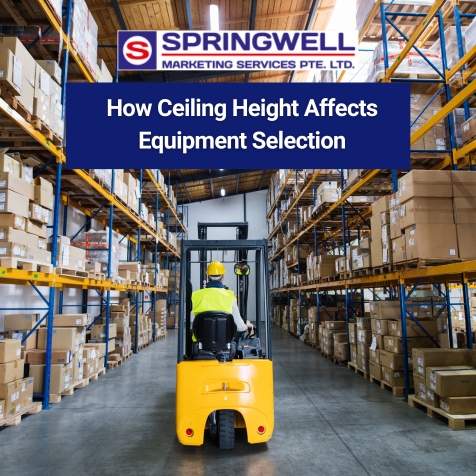
When planning a warehouse, factory, or logistics facility, ceiling height is often overlooked in favour of floor space and layout. However, vertical clearance plays a critical role in determining which material handling equipment can be used safely and efficiently.
From lifting capacity to operator safety, ceiling height directly influences equipment selection and workflow design. Choosing the wrong equipment for the available vertical space can lead to inefficiencies, safety risks, and costly operational changes.
Why Ceiling Height Matters in Material Handling
Ceiling height determines how high loads can be lifted, stacked, or positioned without risk. Insufficient clearance can restrict movement, reduce productivity, and increase the likelihood of collisions or damage.
Ceiling height affects:
- Maximum lifting height
- Equipment mast and platform selection
- Load stability during lifting
- Compliance with safety regulations
Understanding vertical limitations early allows businesses to select equipment that fits both operational needs and physical constraints.
Low Ceiling Environments and Equipment Limitations
Facilities with low ceilings, such as older warehouses or production floors, require compact and low-profile equipment. Standard lifting devices may not operate safely in these environments due to limited overhead clearance.
In low-ceiling spaces, businesses often face:
- Restricted lifting height
- Limited mast extension options
- Reduced stacking or positioning capability
Equipment such as low-profile pallet trucks, compact stackers, and scissor lift tables is often better suited for these conditions, as they provide functionality without excessive vertical reach.
High Ceiling Facilities and Vertical Efficiency
High ceiling environments offer greater flexibility but also introduce unique challenges. While higher lifting capacity enables vertical storage and elevated positioning, it also demands equipment with enhanced stability and control.
In high ceiling facilities, considerations include:
- Mast height and rigidity
- Load balance at extended heights
- Operator visibility and control
- Safety mechanisms for elevated lifting
Selecting equipment designed for vertical operation ensures safety while maximising the benefits of available height.
Impact on Load Handling and Stability
As lifting height increases, so does the importance of stability. Equipment operating near its maximum height must maintain balance to prevent tipping or load shift.
Key stability factors include:
- Equipment base width
- Load centre distance
- Mast design and rigidity
- Floor condition and levelness
Ceiling height influences how often equipment operates at elevated positions, making proper selection essential for consistent and safe handling.
Ceiling Height and Operator Safety
Insufficient clearance increases the risk of collisions with overhead structures such as beams, lighting, ducting, or fire protection systems. Operators may be forced to work with limited visibility or awkward positioning.
To reduce risks, facilities should:
- Measure true usable height, not just structural ceiling height
- Account for fixtures and services below the ceiling
- Select equipment with appropriate lift limits and controls
Proper planning protects both operators and infrastructure.
Choosing the Right Equipment for Available Height
Equipment selection should always start with an accurate assessment of ceiling height and operational requirements.
Consider the following when selecting material handling equipment:
- Maximum required lifting height
- Frequency of elevated operations
- Load weight and dimensions
- Available clearance around work areas
Matching equipment specifications to real-world conditions helps prevent underutilisation or overextension.
Common Equipment Affected by Ceiling Height
Several types of material handling equipment are directly influenced by vertical clearance.
These include:
- Pallet stackers
- Lifting tables and work positioners
- Platform lifts
- Drum handling equipment
Each category offers variations designed for different height requirements, making correct specification crucial.
Planning for Future Operational Needs
While current ceiling height may meet today’s requirements, future changes such as increased production, new workflows, or heavier loads should also be considered.
Forward-thinking equipment selection allows:
- Greater operational flexibility
- Reduced need for future replacements
- Better return on investment
Even within height constraints, choosing adaptable equipment can support long-term growth.
Conclusion
Ceiling height is a key factor that directly impacts material handling equipment selection, safety, and operational efficiency. Whether working in a low-clearance facility or a high-ceiling warehouse, understanding vertical limitations ensures the right equipment is chosen for the task.
By assessing ceiling height alongside load requirements and workflow demands, businesses can avoid costly mistakes and improve day-to-day operations.
At Springwell, we provide a wide range of material handling equipment designed to suit different height constraints and operational environments. With the right equipment in place, facilities can achieve safer handling, improved productivity, and more efficient use of space.