


Types of Trailer Jacks | Their Functions & Capabilities

A variety of weight and length capacities are available with a trailer jack. Users must keep in mind the length of their extended and retracted positions. This equipment must lift the coupling to an elevation so that the vehicle’s hitch ball can straighten itself. While driving, the jack must withdraw far enough away from the road to allow for proper clearance.
What Is a Trailer Jack?
A trailer jack is a device that lifts and maintains a trailer so it may be linked to the towing vehicle.
The trailer jack raises the trailer to a certain height, allowing it to be hooked or unplugged to and from any vehicle.
While on storage, these jacks are able to redirect trailers.
Swivel, A-frame, and drop-leg are some of the most popular types. The hitch is connected to a jack on the horse trailer’s tongue. These jacks are critical for safe pulling.
Trailer Jack Primary Functions
> It assists parked trailers for loading and unloading by stabilising the trailers.
> It elevates and lowers trailers to connect it to the coupler or hook, as well as disconnect it from the ball.
>If the trailer is not secured to the automobile, it can help to keep it in a levelled position.
Types of Trailer Jacks
(1) A-Frame Jacks
The A-Frame trailer jack specifically for the bumper pull and standard ball trailer can weld or lock up into the A-Frame coupler. It can also be positioned in a bracket at the back of your coupler. Standard capacity is between 2,000 and 5, 000 lbs.
It is ideal for use on an A-Frame flat-tire garden trailer, camper, or utility truck. The majority of them are powered by a 12V battery or a hand crank. From the topmost or side, the manual crank revolves.
(2) Side Mount Trailer Jack
The Side Mount trailer jack is attached to the pole’s frame near the tongue. It has a pivot mechanism, allowing the jack to swing up for hauling and down for jacking.
The manual crank is located on one of the sides or tops of the jack.
(3) RV Heavy-Duty and Landing Gear Jack
These jacks are securely fastened to the trailer with buttress supports on both sides, which support the weight of the trailer.
The maximum capacity ranges from 6, 000 to 12, 000 lbs, although some models have a higher capacity.
Landing gear jacks are typically available in pairs.
Drop leg or follow jacks can also be purchased separately.
(4) Jacks Secure Trailers
The Fifth Wheel Trailer Jack, also known as the Gooseneck Hitch Trailing Jack, is a gooseneck hitch-mounted tool that supports the trailer at the gooseneck hitch and provides stability from front to back. The wide footpads prevent tipping and falling. Capacities range from 1,200 to 5,000 lbs.
(5) Bulldog Trailer Jacks
The round jack can handle light loads while coupling, uncoupling, and fixed support. The medium-duty and heavy-duty versions are perfect for combining moderate and hefty-duty reinforcement while connecting and uncoupling, as well as storing trailers.
The Bulldog Two-Speed Square Jack is the ideal solution for hefty weights that require rapid operations and adjustable cranking ratio. The rack and gear jack is the greatest choice for increased stability and scaffolding for trailers with higher tongue weight. It’s also an excellent method to transport rigs on the road or on site.
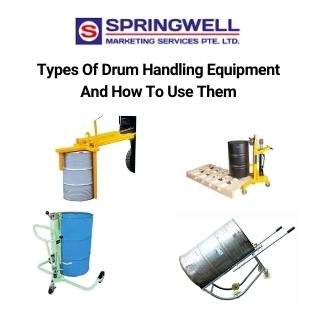
Lifting, moving, or positioning hazardous circular containers without the use of appropriate equipment may result in significant injuries and accidents. Fortunately, there are a variety of sorts of drum handling equipment available that can help your staff and company as a whole.
In this post, we’ll look at what these containers are, five distinct kinds of drum handling equipment in Singapore and how to utilize them, as well as how they may help your business.
What Is A Drum Handling Equipment
A drum handler is an equipment tool that safely grasps, raises, and transports drums , cans, pails, kegs of various materials, including steel barrels, plastic, and fiber. It uses spring-loaded metal arms to provide a tight and secure grip on the barrel of the drum for easy transportation.
Types of Drum Handling Equipment
(1) Drum Lifting Grabs
Grabs are named for the fact that these drum handlers may wrap around the middle of barrels in order to grab them. They can also grasp the top of the rim with a rim grab or gator grip, which is known as a rim grab or gator grip.
The grab attachment simply fits over the forks of a standard forklift.
These are one of the numerous sorts of forklift attachments (that come in single or double capacity) available for transporting items – to lift and transport goods across long distances.
Some types of this product are designed to lift in both horizontal and vertical positions for a variety of purposes. The grasps can attach to the barrels in two ways: by wrapping all the way around the middle, which is how it gets its name, or by grasping the top of the rim, also known as a gator grip or rim grab.
(2) Drum Palletizers
Palletizers, which are similar to pallet jacks but have V-shaped legs that can maneuver around the sides and corners of pallets, are a fantastic choice for placing and removing drums with ease.
They may pick up drums by the top rims to simply lift and move them, or they can wrap around the middle of the drum to tilt and pour the contents.
Palletizers that operate on a V pattern work around the sides and corners of pallets with legs in a V formation. They can grab the top rims of the containment cylinders for easy lifting and moving or wrap around the center, allowing them to tilt and pour the contents or liquids within.
Manually operated palletizers are available in two styles: hand-pumping and battery-powered.
(3) Vertical-lift pourers
These pourers, often known as tippers, tilters, or dumpers, elevate drums vertically to pour out the contents. With complete control over the pouring angle and height, they enable operators to safely pour dangerous products from a safe distance.
The 2 types of vertical-lift pourer:
- Single-stage vertical-lift pourer: can pour from up to 60” high
- Two-stage vertical-lift pourer: can pour goods from up to 106” high
They come in several types of composition:
- Power lift with power tilt: uses both a motor-powered hydraulic lift and tilt
- Power lift with manual tilt: uses a motor-powered hydraulic lift, and a hand crack for tilting the drum
- Manual lift with manual tilt: uses a hand pump for lifting manually, and a hand crank for tilting the drum
(4) Movers
For goods that don’t need to be poured or mixed, movers are a cost-effective alternative.
Dollies: These tiny carts are perfect for maneuvering through narrow aisles. They have rolling wheels that the drum sits on top of, and when the goods have been delivered, a lifter is required to remove the drum from the dolly.
Trucks/Trollies: In one fluid motion, a hydraulically powered forklift can pick up and roll drums. They usually have 2 to 4 wheels – the more wheels, the lighter the operator has to support.
Cradles: The ergonomic design of these cradles allows them to be used for a variety of purposes including carrying drums on their sides for pouring or other functions.
They may also function as a trolley by lifting barrels vertically and then rolling them over.
Some cradles are unable to lift on their own, therefore a lifter is required in this instance.
(5) Mixers / Rotators
This machine is used to combine and combine the contents of barrels, as separation of the product during production is unavoidable. They’re ideal for cutting down on waste, as well as eliminating pollutants from your workstation.
The 2 types of Mixers are:
Roller: a gentle roll of the barrel on its horizontal axis allows for continuous mixing of the contents within (E.g., cement mixers).
Tumbler: The second method is to continuously spin a barrel on its vertical axis – one end over the other – for a more robust combination.
Benefits of Owning a Drum Handling Equipment
> Improved Efficiency and Productivity
It takes far more time and effort to prepare, lift, and transport extremely hefty drums without the appropriate equipment. Drum handling equipment eliminates the requirement for strong and long-lasting workers able to manually handle drums, allowing for quicker, safer, and higher-quality handling. If employees spend less time struggling with heavy loads, they can focus on finishing the task.
> Safer Work Environment
Using drums to store hazardous materials eliminates the chance of injury and promotes a safer work environment for your employees. Heavy drums may be difficult and even dangerous to move due to their capacity reaching 55 gallons. When huge barrels are filled with flammable liquids, this is particularly the case. Using the correct drum handling equipment can help you save time while also protecting your employees.
A drum handling machine might also assist operators in avoiding stress injuries by picking up, moving, and releasing heavy loads. If injuries at work are reduced, including a reduction in injury claims and time off of work – both of which will save the business money in the long run.
> Improved Product Handling, and Quality
Reducing the likelihood of accidents will improve the quality of your product since it will be less vulnerable to damage during handling.
> Monetary Gains In The Long Run
When you prevent injuries, enhance efficiency, and increase productivity, you save time and money – a win-win situation for everyone involved.
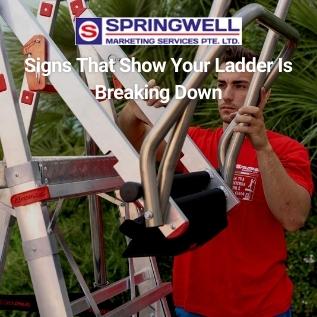
When does an extension ladder need to be replaced or repaired?
The short answer is when it is no longer safe to use.
It should be removed from service and fixed before returning to work.
So, how can you tell when an extension ladder is no longer a good idea? Let’s look at some warning signals for extension ladders.
1. Wobbly Ladder – Loose screws
If your ladder is wobbly, it is not safe to be used. The wobbling could result in the ladder tipping over or you falling off of it. You can repair a wobbly ladder by making sure that all of the ladder’s locks are working properly and tightening any loose screws on the side rails.
2. Rungs Are Hard To Move Up and Down – Loose Rungs
If your ladder’s rungs are hard to move, it could be because the locking mechanism is not working correctly. You should replace your ladder’s locks before continuing to use it.
A loose rung indicates that your extension ladder needs to be repaired. So instead of using the ladder again, pull it off the job and have it fixed before you use it again.
3. One Side Of The Ladder Is Lower Than The Other
If one side of your extension ladder is lower than the other, without testing it you can be sure that the side that is not touching the ground is weak or damaged in some way. When this happens, pull the ladder off of the job immediately and bring it to a professional as well.
4. Damaged / Cracked Feet
The feet at the base of your extension ladder are what keep it stable when you go up it. If they are damaged or cracked, do not use them. Call a professional to get your ladder fixed before you continue to use it.
The feet are a typical location for an extension ladder to break. If the feet are cracked or exhibit excessive wear, you might be able to replace or repair them before using the ladder again.
Can an Extension Ladder Be Repaired?
Occasionally, your extension ladder might require repair and can be fixed for a lower price than a new one. A damaged ladder may sometimes be restored to its original condition, however this isn’t always the case – as extension ladder like many equipment have their own lifespan.
If you inspect your extension ladder before each usage and discover any problems, you may be able to repair it. However, if there is too much damage or it is too serious, it may be time to purchase a new one.
Whether you fix an old extension ladder or buy a new one, it’s critical to ensure that you use the ladder safely. Always examine your ladders before using them and keep an eye out for warning signs that indicate your extension ladder needs to be replaced.
If you are still unsure if your platform ladder needs fixing, contact us request for an equipment repair solution from Springwell Marketing.

If you are new to using a stepladder, a few things will help you know you’re using a stepladder safely. Without the proper instructions, you could be in danger of falling and becoming injured.
1. Inspect your ladder’s condition
Make sure that the stepladder you are using is in good condition with no loose bolts, cracked or splintered wood. The side rails must be intact and not excessively worn. Stepladders should not be used when they are wet because the foot rungs could slip out from under you causing serious injury.
2. Watch out for your surroundings
Worried about where you are stepping when using the ladder? Who isn’t!
To make sure you are safe while on top of your ladder, be sure to check around yourself before moving the stepladder.
3. Ensure the ladder is rated for your weight and any other extra load
It is vital to understand how much weight the stepladder can support as a newbie. Not all ladders are made equal, and they have varying maximum weight capacities. Before you start using your ladder, verify its weight capabilities.
An important detail to remember about stepladders is that smaller ladders may not be able to hold as much weight. This means that you should avoid placing an excessive amount of pressure on the top two steps, where most of your weight will rest while standing on it.
4. Make sure the stepladder is on a flat, level surface before using it
You may need someone to hold the ladder steady for you so it doesn’t fall over when you climb up or down it. Be aware of any obstructions nearby that may interfere or cause the stepladder to tip.
5. Avoid the top step
The majority of stepladders will include a warning label telling you not to stand above a specific step. Regardless of whether or not there is a sticker, you should never stand on the top step of the ladder.
6. Never over extend yourself
When using a ladder it’s important to make sure you are completely comfortable with the height of the stepladder before leaning on the handle. If you aren’t able to comfortably reach your desired location without straining yourself, it is time to place another step onto your ladder.
7. Using the stepladder properly – three point of contact
When you are on a stepladder, you should have three points of contact at all times. This means having two hands and one foot on the ladder or two feet and one hand at all times. It is possible that this is the most essential safety advice in this article.
When using a stepladder, it’s important to know that the front two feet should rest on the ground or floor while standing on the next highest step of the ladder. The back two feet should remain firmly planted on the step above. This gives you more balance and stability while climbing up and down steps.
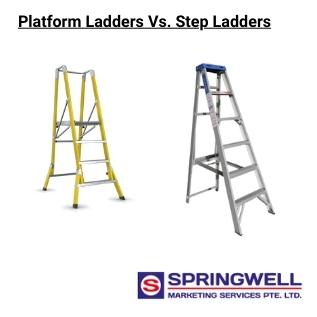
When it comes to workplace safety and even home safety, ladders have been cited as one of the leading causes for injury. One of the major reasons so many accident occur with a ladder is simply because the wrong ladder was chosen for the job.
A step ladder may be the perfect choice for one type of job, while a platform ladder may work better for another. Here’s a quick look at the differences between step ladders and platform ladders.
The Key Difference Between a Step Ladder and a Platform Ladder


There are a few small distinctions between these two styles of ladders, but the most significant distinction is the actual platform on the platform ladder. You’ll be standing on a 3″ ladder rung with a step ladder, but a platform ladder offers considerably more foot space.
The user may stand with both feet firmly planted on a surface that is usually 12′′ x 18′′ or larger. On the other hand, users will be standing just on a step if they were using a step ladder.
The Cost
Although a platform ladder is typically less expensive than a step ladder, the additional size of a larger standing surface makes it worthwhile in certain circumstances. In many cases, the user may stand at the same height on a bigger platform as he or she can do on a ladder rung of a step ladder.
The user will be standing at the same height on the platform as they would on the second rung down on an 8-foot step ladder, when compared to a 6-foot platform ladder. Because it is against basic ladder safety guidelines to stand higher than the 2nd rung on a step ladder, it’s obvious how much greater area this provides.
A platform ladder is often a superior choice than a step ladder in many situations. Step ladders, on the other hand, are usually less expensive and may be a wonderful low-cost option. Regardless of the ladder you pick, ensure that you understand basic ladder safety before using it for any task.
Advantages of a Platform Ladder
1) More Secured – Good Balance When Locked
One more security element is that when they are opened up, the platform in fact locks the ladder in the place. This element, in addition to all the truth that they have a little broader position and are weightier, creates a good deal additional balance when upright.
2) Mechanism That Discourages Users From Leaning Them Against Walls
Another pro or advantage is that, if they are utilized as designed by their layout, they stop employees from dealing with them in leaning them against walls, because of the reality that the function platform will not fall into position except if the ladder is opened up.
3) It’s Dimension Creates a Secure Footing
Yet an additional pro is its dimension, that creates an additional secure footing for the employee.
4) Designed For Long Standing At One Specific Height
A significant advantage of the Ladder is that the platform is designed for a long standing at one specific height and is significantly simpler on the feet.
With regular step ladders, the worker has a step over the arches from the feet and may result in discomfort with extended use.
Disadvantages of a Platform Ladder
1) Heavier Option
Platform ladders are heavier and bulkier than step ladders since they increase the burden of transporting them, especially the taller ones.
2) Many Do Not Come With An Option To Hang Equipment
A platform ladder does not have any space for equipment while functioning. However, the majority of step ladders come with a large prime shelf as well as numerous screwdriver slots and holes.
Staff who are used to using this material for tools may find it a nuisance, especially because the majority of step ladders do not have any provisions. There is just a cross-brace at the top that serves as a security railing.
3) A Possible Security Hazard At Times
The platform itself might also become a security risk. Because there is no possibility for moving near to each other when standing on a typical ladder’s step, every time a worker is stationary. Workers may be tempted to manoeuvre about as a result of the area provided by the platform step.
Choosing The Right Ladder For Reach
To calculate the length of a stepladder, add the height of the ladder when opened to half its overall length. For example, if your stepladder measures 12’2″ long and 6’10” tall when open, you’ll want to use a maximum height of 8 feet and a minimum distance between rungs of 1 foot 9 inches.
Extension ladders have certain further factors to think about. Based on the same physical characteristics of the person described above, the maximum ladder length and highest standing level come into play here.
Choosing The Right Ladder For The Kind of Job You Would Be Using It For
At the end of the day, choosing the right ladder really depends on the kind of job that you will be using it for. This will influence your decision to choose a ladder with different features and attributes such as:
- Is it lightweight?
- How strong and durable must it be?
- Does it have to be weather-resistant’
- Does it need to be able to resist corrosion
- Does it need to be catered for heavy-duty handling
- Is it suitable for my daily work activities: e.g. painting, roofing, or just managing warehouse storage
If you are unsure of which type of ladder will suit your needs, consult our material handling equipment specialists today.