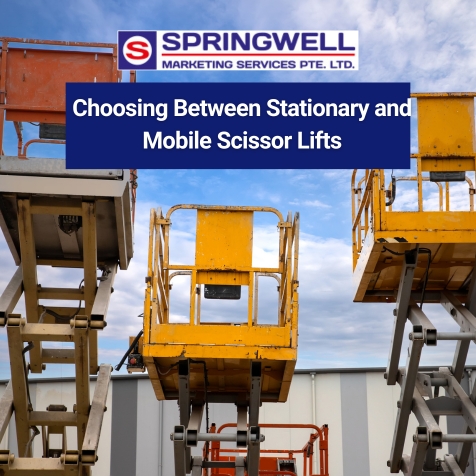
When it comes to lifting heavy loads or working safely at height, scissor lifts are one of the most versatile tools in material handling and industrial operations.
From warehouse facilities and production lines to logistics and maintenance work, scissor lifts make it easier to lift goods, equipment, or personnel with minimal effort and maximum stability.
But not all scissor lifts are the same. The two most common types — stationary scissor lifts and mobile scissor lifts — are designed for different applications. Understanding their differences can help you choose the right one for your workflow, efficiency, and budget.
What Is a Scissor Lift?
A scissor lift is a platform that raises vertically through linked, folding supports arranged in a crisscross “X” pattern — resembling the movement of a pair of scissors.
These lifts are powered either hydraulically, electrically, or pneumatically, and are used to safely raise goods or people to a desired height. Depending on the model, they can handle anywhere from a few hundred kilograms to several tonnes.
In material handling, scissor lifts are invaluable for:
- Loading and unloading pallets
- Lifting goods to mezzanine levels or conveyors
- Supporting assembly or maintenance tasks
- Improving ergonomics by adjusting working heights
The Two Main Types: Stationary vs Mobile
While both serve the same core purpose — vertical lifting — stationary and mobile scissor lifts differ significantly in mobility, capacity, and intended use.
Here’s a closer look at what sets them apart.
Stationary Scissor Lifts
Overview
A stationary scissor lift (also known as a hydraulic lift table) is fixed in one location, usually bolted or built into the floor. It’s ideal for handling heavy loads in repetitive operations where the lifting point doesn’t change.
Key Features
- High load capacity – typically ranges from 1,000 kg to over 10,000 kg.
- Stable lifting platform – provides excellent support for heavy, uneven, or large goods.
- Customisable size and stroke height – can be designed for specific applications or heights.
- Electric or hydraulic operation – ensures smooth, controlled lifting.
Common Applications
- Production lines and assembly stations
- Loading bays and goods lifts between floors
- Integration with conveyors or packaging systems
- Ergonomic workstations to reduce bending and lifting strain
Advantages
- Extremely stable and durable
- Handles very heavy loads safely
- Low maintenance with long service life
- Can be customised for platform size, height, and capacity
Limitations
- Fixed in place – not suitable for multi-location use
- Requires installation and sometimes pit mounting
- Less flexible for operations with changing layouts
If your operation involves repetitive lifting in a fixed spot, such as loading pallets or supporting conveyor lines, a stationary scissor lift is likely the better investment.
Mobile Scissor Lifts
Overview
A mobile scissor lift is mounted on wheels or casters, allowing operators to move it between different areas. These lifts are designed for flexibility, quick deployment, and light to medium load handling.
Key Features
- Portable design with push or power-assisted movement
- Load capacity typically between 300 kg and 1,500 kg
- Manually operated or battery-powered lift mechanisms
- Lockable wheels for stability during operation
Common Applications
- Maintenance or repair work at variable heights
- Order picking and light goods transfer
- Stock shelving and warehousing
- Facility cleaning, signage, or light installation tasks
Advantages
- Highly mobile — can be used in multiple areas
- Easy to operate and reposition
- Ideal for maintenance or light lifting tasks
- No permanent installation needed
Limitations
- Lower load capacity compared to stationary models
- Can be less stable on uneven floors
- Requires manual effort (for non-powered versions)
- Not suited for very heavy or high-frequency lifting
A mobile scissor lift is best suited for teams that need flexibility — especially in environments where work zones change frequently, such as maintenance departments, retail warehouses, or facilities management.
How to Decide Which Type You Need
When choosing between a stationary and mobile scissor lift, consider the following factors:
1. Load Weight
If you regularly lift heavy materials or pallets exceeding 1,500 kg, a stationary lift offers the strength and durability you need. For lighter loads and manual handling tasks, a mobile lift is sufficient.
2. Frequency of Use
High-frequency, repetitive lifting (such as production lines or loading docks) benefits from a stationary lift’s stability and power. In contrast, occasional lifting across multiple work areas calls for a mobile lift.
3. Mobility and Layout
If your workspace layout is fixed, go with a stationary model. But if you operate across various zones or need to move the lift often, mobility becomes essential.
4. Height Requirement
Stationary lifts can be built to reach greater heights and handle heavier goods. Mobile lifts usually offer limited lift height for safety and balance reasons.
5. Space and Installation
Stationary lifts require dedicated floor space or even pit installation. Mobile models can be easily stored or repositioned when not in use.
6. Budget and Long-Term Value
Stationary lifts may require a higher upfront investment, but often deliver better long-term efficiency and durability. Mobile lifts cost less initially and provide more flexibility, but may need more frequent maintenance.
Safety Considerations
Both types of scissor lifts should always be operated according to manufacturer guidelines. Key safety practices include:
- Never exceeding rated load capacity
- Ensuring the platform is on a stable, level surface
- Performing regular maintenance and hydraulic checks
- Using wheel locks on mobile lifts before operation
- Providing proper operator training
Springwell’s scissor lifts are designed with built-in safety features, including overload protection valves, emergency stop buttons, and anti-skid platforms for maximum operator safety.
The Springwell Advantage
At Springwell, we supply a comprehensive range of stationary and mobile scissor lifts for industrial, warehouse, and commercial applications in Singapore.
Our equipment is engineered for durability, smooth hydraulic performance, and compliance with international safety standards. Whether you need a fixed scissor lift for production lines or a mobile model for facility maintenance, our team can help you choose the best solution for your operations.
We also provide custom configurations — from platform dimensions to lift heights and capacities — ensuring every lift fits your specific workflow.
Final Thoughts
Both stationary and mobile scissor lifts have their strengths. The right choice depends on your load requirements, space, and operational needs.
- If you prioritise strength, stability, and heavy-duty performance, go with a stationary scissor lift.
- If you value mobility, flexibility, and light-duty versatility, a mobile scissor lift is the smarter pick.
Not sure which model fits your needs? Contact Springwell today, and we’ll help you find the ideal scissor lift or other material handling equipments in Singapore for your safety, productivity, and budget requirements.