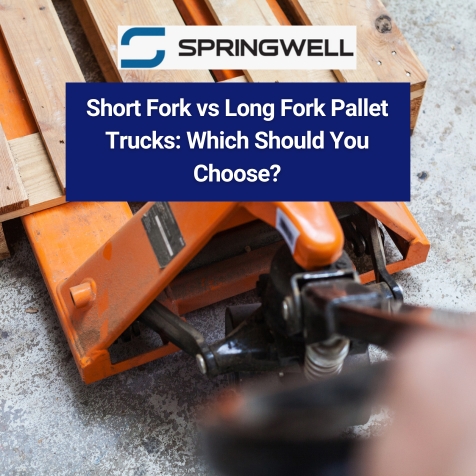
When purchasing a pallet truck, most businesses focus on load capacity, wheel material, or overall durability.
However, one specification that often gets overlooked is fork length.
Choosing between a short fork and a long fork pallet truck can have a significant impact on productivity, manoeuvrability, and workplace safety. The right option depends largely on the type of pallets you handle, the available operating space, and the nature of your daily material handling tasks.
Today, we’ll explore the differences between short fork and long fork pallet trucks to help you determine which option is best suited for your operation.
Understanding Fork Length in Pallet Trucks
Fork length refers to the distance from the heel of the fork to the fork tip.
While dimensions vary between models, pallet trucks generally fall into two categories:
Short Fork Pallet Trucks
- Typically between 800mm and 1000mm
- Designed for smaller pallets and confined spaces
Long Fork Pallet Trucks
- Typically between 1500mm and 2500mm
- Designed for larger pallets and longer loads
The choice is not simply about handling heavier loads. Fork length affects how easily you can move pallets, navigate aisles, and transport oversized materials.
When Short Fork Pallet Trucks Make More Sense
Short fork pallet trucks are commonly used in environments where space is limited.
Their compact design makes them easier to manoeuvre through narrow aisles, tight storage areas, and congested workspaces.
Businesses often choose short fork pallet trucks for:
- Retail backrooms
- Small warehouses
- Workshops
- Production areas with limited floor space
- Loading and unloading within confined areas
Because the forks are shorter, operators can make tighter turns and position loads more accurately.
Advantages of Short Fork Pallet Trucks
Better Manoeuvrability
One of the biggest benefits of short forks is improved handling.
Operators can navigate narrow aisles and crowded storage areas more easily compared to longer models.
Easier Positioning
Shorter forks allow for more precise pallet placement, particularly when working in compact storage systems.
Suitable for Small Pallets
Many businesses handle half pallets, custom pallets, or smaller loads that do not require standard-length forks.
Using shorter forks prevents unnecessary overhang and improves stability.
Limitations of Short Fork Pallet Trucks
Despite their advantages, short forks may not be suitable for every application.
They can struggle with:
- Large pallets
- Long materials
- Double pallet handling
- Oversized industrial loads
Insufficient fork support can affect load stability and increase handling risks.
When Long Fork Pallet Trucks Are the Better Choice
Long fork pallet trucks are designed for handling larger and longer loads.
They provide greater support across the entire pallet, reducing the likelihood of load shifting during transportation.
These models are commonly used in:
- Warehouses handling oversized pallets
- Manufacturing facilities
- Distribution centres
- Logistics operations
- Industrial environments with bulky materials
Long forks are especially useful when moving non-standard loads that extend beyond the dimensions of conventional pallets.
Advantages of Long Fork Pallet Trucks
Improved Load Support
Longer forks distribute weight more evenly across the pallet.
This helps maintain load stability during movement.
Ability to Handle Larger Pallets
Long fork pallet trucks can accommodate oversized pallets that would otherwise be difficult to transport safely.
Greater Efficiency for Large Loads
In some operations, long forks allow operators to move larger quantities of materials in a single trip, reducing handling time.
Limitations of Long Fork Pallet Trucks
While they offer greater load support, long forks require more operating space.
Businesses may encounter challenges such as:
- Reduced manoeuvrability
- Larger turning radius
- Difficulty navigating narrow aisles
- Increased storage space requirements
In facilities where space is limited, these factors can affect overall workflow efficiency.
Key Factors to Consider Before Choosing
Pallet Size
The first consideration should always be the size of the pallets being handled.
A pallet truck should provide adequate support without excessive overhang.
Using forks that are too short may compromise load stability, while excessively long forks can make manoeuvring more difficult than necessary.
Available Workspace
Consider your operating environment.
If your warehouse contains narrow aisles and tight turning points, short forks may provide significant operational advantages.
For larger warehouses with wider access routes, long forks may offer greater flexibility.
Type of Materials Handled
Certain industries frequently transport oversized products such as:
- Building materials
- Industrial equipment
- Long cartons
- Manufacturing components
These applications often benefit from longer fork configurations.
Operational Efficiency
Fork length can directly impact productivity.
The right choice allows operators to move loads safely, while maintaining smooth workflow throughout the facility.
Selecting a pallet truck that matches your daily operations can reduce handling time and improve overall efficiency.
Is There a “Best” Fork Length?
There is no single fork length that works for every business.
A short fork pallet truck may be ideal for a retail stockroom but completely unsuitable for a manufacturing facility handling oversized components.
Likewise, a long fork pallet truck may excel in a distribution centre while becoming cumbersome in a small warehouse.
The best solution depends on balancing:
- Load size
- Available space
- Handling requirements
- Workplace layout
- Productivity goals
Evaluating these factors carefully will help ensure you choose a pallet truck that supports both safety and operational performance.
Final Thoughts
Fork length is one of the most important, yet often overlooked considerations when selecting a pallet truck.
Short fork pallet trucks offer superior manoeuvrability and are ideal for confined spaces, while long fork pallet trucks provide better support for oversized pallets and longer loads.
Rather than choosing based solely on load capacity, businesses should assess their warehouse layout, pallet dimensions, and handling requirements to determine the most suitable option.
The right pallet truck can improve efficiency, reduce handling risks, and support smoother day-to-day operations.
Find the Right Pallet Truck for Your Operations
At Springwell, we supply a wide range of pallet trucks designed to meet the needs of warehouses, factories, logistics facilities, and industrial operations.
Whether you require a compact short fork pallet truck for tight spaces or a long fork model for oversized loads, our team can help you identify the most suitable solution for your requirements.
Contact Springwell today to explore our range of material handling equipment and improve the efficiency of your workplace operations.