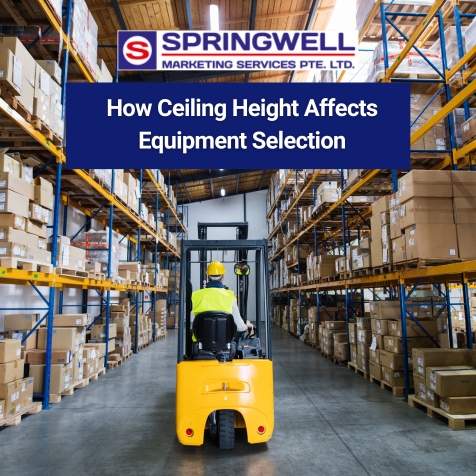
When planning a warehouse, factory, or logistics facility, ceiling height is often overlooked in favour of floor space and layout. However, vertical clearance plays a critical role in determining which material handling equipment can be used safely and efficiently.
From lifting capacity to operator safety, ceiling height directly influences equipment selection and workflow design. Choosing the wrong equipment for the available vertical space can lead to inefficiencies, safety risks, and costly operational changes.
Why Ceiling Height Matters in Material Handling
Ceiling height determines how high loads can be lifted, stacked, or positioned without risk. Insufficient clearance can restrict movement, reduce productivity, and increase the likelihood of collisions or damage.
Ceiling height affects:
- Maximum lifting height
- Equipment mast and platform selection
- Load stability during lifting
- Compliance with safety regulations
Understanding vertical limitations early allows businesses to select equipment that fits both operational needs and physical constraints.
Low Ceiling Environments and Equipment Limitations
Facilities with low ceilings, such as older warehouses or production floors, require compact and low-profile equipment. Standard lifting devices may not operate safely in these environments due to limited overhead clearance.
In low-ceiling spaces, businesses often face:
- Restricted lifting height
- Limited mast extension options
- Reduced stacking or positioning capability
Equipment such as low-profile pallet trucks, compact stackers, and scissor lift tables is often better suited for these conditions, as they provide functionality without excessive vertical reach.
High Ceiling Facilities and Vertical Efficiency
High ceiling environments offer greater flexibility but also introduce unique challenges. While higher lifting capacity enables vertical storage and elevated positioning, it also demands equipment with enhanced stability and control.
In high ceiling facilities, considerations include:
- Mast height and rigidity
- Load balance at extended heights
- Operator visibility and control
- Safety mechanisms for elevated lifting
Selecting equipment designed for vertical operation ensures safety while maximising the benefits of available height.
Impact on Load Handling and Stability
As lifting height increases, so does the importance of stability. Equipment operating near its maximum height must maintain balance to prevent tipping or load shift.
Key stability factors include:
- Equipment base width
- Load centre distance
- Mast design and rigidity
- Floor condition and levelness
Ceiling height influences how often equipment operates at elevated positions, making proper selection essential for consistent and safe handling.
Ceiling Height and Operator Safety
Insufficient clearance increases the risk of collisions with overhead structures such as beams, lighting, ducting, or fire protection systems. Operators may be forced to work with limited visibility or awkward positioning.
To reduce risks, facilities should:
- Measure true usable height, not just structural ceiling height
- Account for fixtures and services below the ceiling
- Select equipment with appropriate lift limits and controls
Proper planning protects both operators and infrastructure.
Choosing the Right Equipment for Available Height
Equipment selection should always start with an accurate assessment of ceiling height and operational requirements.
Consider the following when selecting material handling equipment:
- Maximum required lifting height
- Frequency of elevated operations
- Load weight and dimensions
- Available clearance around work areas
Matching equipment specifications to real-world conditions helps prevent underutilisation or overextension.
Common Equipment Affected by Ceiling Height
Several types of material handling equipment are directly influenced by vertical clearance.
These include:
- Pallet stackers
- Lifting tables and work positioners
- Platform lifts
- Drum handling equipment
Each category offers variations designed for different height requirements, making correct specification crucial.
Planning for Future Operational Needs
While current ceiling height may meet today’s requirements, future changes such as increased production, new workflows, or heavier loads should also be considered.
Forward-thinking equipment selection allows:
- Greater operational flexibility
- Reduced need for future replacements
- Better return on investment
Even within height constraints, choosing adaptable equipment can support long-term growth.
Conclusion
Ceiling height is a key factor that directly impacts material handling equipment selection, safety, and operational efficiency. Whether working in a low-clearance facility or a high-ceiling warehouse, understanding vertical limitations ensures the right equipment is chosen for the task.
By assessing ceiling height alongside load requirements and workflow demands, businesses can avoid costly mistakes and improve day-to-day operations.
At Springwell, we provide a wide range of material handling equipment designed to suit different height constraints and operational environments. With the right equipment in place, facilities can achieve safer handling, improved productivity, and more efficient use of space.