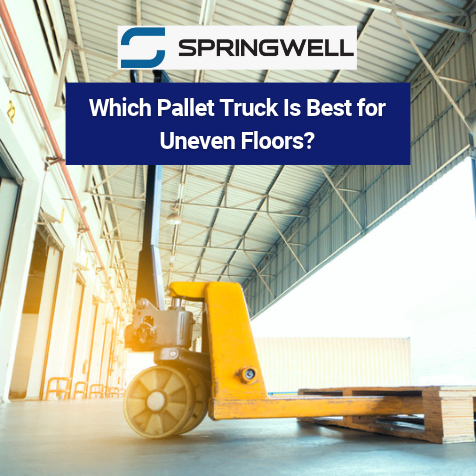
Quick answer: For a warehouse floor with small joints, cracks or dips, a manual pallet truck with tandem (bogie) load rollers is usually enough. If the ground is rough, badly damaged or outdoors, go for a rough terrain pallet truck with large pneumatic or solid tyres. The right choice comes down to how bad the surface is, how heavy your loads are and where the truck needs to travel.
On smooth concrete, almost any pallet truck works. On uneven ground, the wrong one takes more effort to push, shakes the load and wears out its wheels and parts faster. Start by matching the truck to your floor.
Which Pallet Truck Should I Choose for My Floor?
|
Your floor |
Best option |
What to check |
|---|---|---|
|
Mostly level with occasional floor joints |
Manual pallet truck with tandem rollers |
Roller configuration |
|
Cracked or uneven indoor concrete |
Manual pallet truck with tandem rollers |
Wheel size, roller configuration and ground clearance |
|
Outdoor paths, gravel, construction sites |
Rough terrain pallet truck |
Tyre type (pneumatic or solid) and frame strength |
|
Smooth floors, heavy loads over long distances |
Electric pallet truck |
Manufacturer’s approved floor conditions |
|
Ramps and slopes |
Depends on the model |
Operating limits and the manufacturer’s guidance for safe handling |
|
Severely damaged floor |
Repair the floor first |
Fixing the surface may be safer and cheaper than relying on special wheels |
Manual Pallet Truck With Tandem Rollers
This is the practical choice for warehouses that are mostly level with a few rough spots.
- Moves goods over short distances without powered equipment
- Tandem rollers cross small joints and uneven patches more easily than single rollers
- Not built for regular travel over gravel, loose soil or badly damaged floors
Rough Terrain Pallet Truck
Choose this if your work takes you outdoors, onto construction sites or across rough concrete.
- Larger pneumatic or solid tyres give better cushioning and clear obstacles that would stop small warehouse rollers
- Some models have adjustable forks to fit different pallet sizes
- Good for moving goods between indoor and outdoor areas
Best for:
- Construction sites and outdoor material handling areas
- Uneven concrete and rough pathways
- Gravel and other firm but irregular surfaces
- Routes that cross from indoor to outdoor work areas
If your warehouse only has minor imperfections, a rough terrain model is likely more than you need. Check your actual working conditions before buying one.
Electric Pallet Truck
An electric pallet truck makes sense if you regularly move heavy loads over longer distances. Powered movement cuts the physical effort for operators and speeds up handling in busy warehouses.
The catch: many electric models are designed for smooth warehouse floors only. If your floor is rough, check the manufacturer’s specs for wheel configuration, ground clearance and approved floor conditions. Don’t assume an electric truck can handle outdoor terrain.
What Makes a Pallet Truck Better on Uneven Floors?
Three things matter most: the load rollers, the wheel material, and the ground clearance and fork design.
Tandem (Bogie) Load Rollers
Tandem rollers are the single most useful feature for slightly uneven warehouse floors.
|
Single load rollers |
Tandem (bogie) load rollers |
|
|---|---|---|
|
Setup |
One wheel at each fork end |
Two wheels paired together at each fork end |
|
Load spread |
One contact point per fork |
Load shared across more contact points |
|
On joints and small bumps |
Rougher ride |
Smoother movement |
|
Roller wear |
Each roller takes the full load |
Less wear on individual rollers |
|
Best for |
Smooth, level floors |
Concrete joints and minor floor irregularities |
Tandem rollers also make the truck more stable when handling pallets.
Wheel Material
Wheel material affects how easily the truck rolls, how much noise it makes and how it treats your floor.
|
Wheel material |
Main characteristics |
Best for |
|---|---|---|
|
Nylon |
Hard-wearing, low rolling resistance on smooth surfaces |
Hard, level warehouse floors and heavy loads |
|
Polyurethane (PU) |
Quieter, protects the floor |
General warehouse use and finished floors |
|
Rubber |
More cushioning and grip on some surfaces |
Some irregular or damp floors |
|
Pneumatic tyres |
Absorb bumps, most cushioning |
Rough outdoor surfaces and uneven ground |
PU wheels are a popular all-rounder for warehouses. Nylon suits hard, smooth floors where easy rolling matters. For tougher outdoor conditions, standard warehouse wheels won’t give enough cushioning, which is where a rough terrain pallet truck comes in. Always check the choice against your floor and the manufacturer’s specifications.
Ground Clearance and Fork Design
Low clearance means the truck can catch on raised thresholds, ramps or uneven sections, making the load harder to move safely. Forks also need to match your pallets so the load is properly supported.
Before you buy, check these against your pallets and workspace:
- Minimum fork height
- Maximum lifting height
- Overall dimensions
What Else Should I Check Before Buying a Pallet Truck?
1. Load Capacity
The truck must be rated for the heaviest pallet you expect to move. Pushing heavy loads over uneven ground takes more effort and puts more strain on the equipment, so never go over the rated capacity.
Our guide on how to calculate the load capacity you need walks through this.
2. Pallet Dimensions
Fork lengths and widths vary. Match them to the pallets you actually use, whether that’s standard pallets, wider industrial pallets or a mix of sizes across different work areas.
3. Where the Truck Will Be Used
- Indoor warehouse: quiet operation and floor protection matter more
- Outdoor or construction site: larger tyres and a tougher frame matter more
- Both: pick a model built for every surface on the route, not just one part of it
4. Maintenance
Uneven floors mean more impact and faster wear on wheels and rollers. To catch problems early:
- Inspect wheels regularly for damage
- Make sure they spin freely
- Clear debris caught around the axles
- Service hydraulics and moving parts according to the manufacturer’s recommendations
For more on safe day-to-day handling, see how to use a pallet truck safely. For the wider workplace rules, Singapore’s WSH Council points employers to SS 569, the Code of Practice for manual handling.
Common Mistakes When Buying a Pallet Truck for Uneven Floors
- Picking wheels on price alone. Cheaper wheel materials may not suit your floor or your loads.
- Using a standard pallet truck on rough outdoor ground. Small warehouse rollers can’t handle gravel, potholes or loose surfaces.
- Skipping tandem rollers. Single rollers struggle more when you cross floor joints or small bumps every day.
- Overlooking load capacity. The truck has to be rated for the weight you’re moving.
- Not inspecting the floor. Severe cracks, broken concrete, and sudden level changes may need repairing, not crossing over and over.
Need Help Choosing a Pallet Truck?
Springwell supplies manual, electric and specialty pallet trucks for warehouses, factories and outdoor sites across Singapore.
Tell us your floor conditions, pallet sizes, and typical load weights, and we’ll recommend a model that fits.