


Understanding Security Cage and its Uses
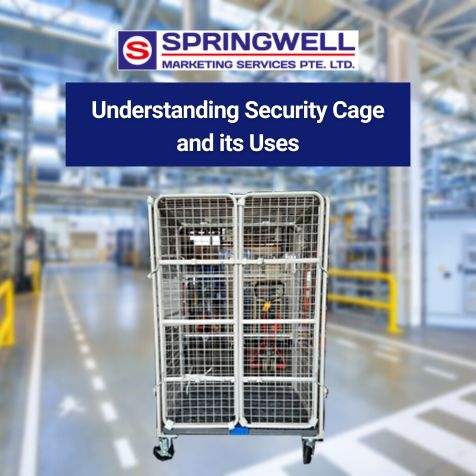
Security cages are a popular tool for protecting property, both public and private. From airports to warehouses, security cages have become an essential component of modern-day life.
But what exactly are they, and how do they serve their purpose?
What Is a Security Cage?
A security cage is a heavy-duty enclosure made of metal mesh that protects from theft or vandalism. It is typically used in warehouses, airports, shopping centres and other public places to protect high-value items or products from being stolen or damaged.
The cage is designed to be difficult to break open or climb over and often includes a secure lock that requires a key or combination code to open.
Benefits of Using Security Cages
The primary advantage of using security cages is that they provide an added layer of protection for valuable items. Not only do they make it more difficult for thieves to get access, but they also function as a strong deterrent.
Potential thieves will be discouraged by the sight of the security cage and may not even attempt to steal or vandalize your property.
Security cages are also advantageous for keeping things organized and secure while still allowing easy access. For example, you can keep items like office supplies in a security cage that can be keyed for staff members to retrieve items when needed.
This provides a neat and secure environment that can help reduce the risk of missing or stolen items.
Types of Security Cages
There are many different types of security cages available, so it is important to consider your needs before making a purchase. Some popular options include:
- Freestanding cages: These are usually four-sided enclosures that can be set up in any location. They provide the most protection and come with various levels of security, such as padlocks or combination codes.
- Wall-mounted cages: These are typically two-sided enclosures that attach to walls or ceilings. They offer a higher level of security than freestanding cages and can be used in areas with limited floor space.
- Expandable cages: These enclosures are ideal for businesses that need to increase their security quickly and easily. They’re made of expandable metal bars and can be set up in minutes.
Common Uses of Security Cages
Security cages have numerous applications, but they’re most commonly used in warehouses, airports and shopping centres. Here are some of the ways they can be used to protect valuable items:
- Warehouses: Security cages can be used to store products, tools or supplies that need to be kept safe from theft or damage. They also help maintain order and organization by keeping items separated and secure.
- Airports: Security cages can be used to store valuable equipment, baggage or items that need to be kept away from the public. They’re also commonly used in restricted areas like airport control towers and check-in counters.
- Shopping centres: Security cages are often used by retailers to protect high-value items such as jewellery or electronics. They also provide an added layer of security for staff members working in the store.
Takeaway
Security cages are an effective way to protect property and deter thieves. From warehouses to airports, security cages provide an added layer of protection that can help keep valuable items safe.
With so many types of security cages available, there is bound to be one that meets your needs and budget. Investing in a security cage could save you time and money in the long run.

Material handling is an essential part of any industrial or manufacturing process. It involves the movement, storage, and control of materials in a facility. Material handling equipment (MHE) refers to the mechanized equipment used to facilitate this.
Such machinery can have both manual and automated components and include cranes, conveyors, elevators, jacks, hoists, pallet jacks, and forklifts.
Types of Material Handling Equipment
1) Cranes
These are machines that can raise and lower materials to different heights, making material handling more flexible. They are useful for transporting large objects or moving them between different areas.
Some common types of cranes include overhead, gantry, jib, and monorail cranes.
2) Conveyors
These are machines designed to transport materials in various directions, such as horizontally, vertically, or at an angle. Their purpose is to facilitate the quick and efficient movement of items over long distances.
Types of conveyors include belt, roller, vibratory, screw, chain-driven live roller, magnetics, drag-chain and power-and-free conveyors.
3) Elevators
These are machines that lift and lower materials vertically. They can be used to move items between different floors of a multi-story building, or even from one level to another in an industrial setting.
Some common types of elevators include pneumatic vacuum elevators, belt elevators, and escalators.
4) Jacks
These are machines used to lift and lower heavy objects. They typically come in two varieties – hydraulic jacks and screw jacks – which use different methods for lifting materials.
Hydraulic jacks use a system of pumps and cylinders while screw jacks use a mechanical screw thread mechanism to move the object up or down as needed.
5) Hoists
A hoist is a device used to move large, heavy objects. It can be used to lift and lower materials with the help of chains or ropes.
Hoists come in various sizes and types such as electric chain hoists, air-powered hoists, manual chain hoists, and wire rope hoists.
6) Forklifts
This type of equipment is used to transport heavy materials from one area to another. It typically consists of a lift truck equipped with forks that can be raised and lowered as needed.
They come in many different sizes and configurations, including electric, propane-powered, or diesel-powered models.
Takeaway
Using material handling equipment is crucial in industrial and manufacturing processes to move materials securely and effectively. The mentioned equipment types are among the most frequently utilized, but there are many more available to cater to different facility requirements.
With the right combination of MHE, businesses can optimize their operations and increase efficiency.

A stairclimber is a type of material handling equipment used to move goods up and down stairs. They are commonly used in warehouses, factories, offices, and other commercial or industrial settings.
While they can be operated manually, electric stairclimbers are the most popular choice due to their ease of use and increased productivity.
Primary Components
The two primary components of stairclimbers are the drive wheels, which are responsible for lifting the load and providing traction, and the wheelbase, which bears the weight of the machine.
Typically, an electric motor powers the drive wheels and the wheelbase is made of strong steel reinforcement.
Operation
The operation of an electric stairclimber is relatively simple.
The operator operates a control panel or remote to move the item up or down the stairs while standing behind it. The drive wheels provide traction and pull the wheelbase upward when moving upwards.
To move downwards, a system of pulleys is used to lower the wheelbase with gravity. This method reduces operator fatigue and ensures safe and secure transportation of goods.
Benefits
Using stairclimbers can effectively transport goods up and down stairs with ease in material handling. This reduces the time and manpower needed for such operations.
Furthermore, an electric stairclimber can enhance safety and security by eliminating accidents linked to incorrect lifting techniques or physical strain.
Safety Features
Electric stairclimbers have various safety features that ensure the safety of the operator and the items being transported. T
These safety features consist of an emergency stop button, anti-tip protection, speed control, and overload protection. Together, they guarantee that items are transported securely and safely.
Safety Precautions
Although electric stairclimbers are designed to be used safely, operators should take certain precautions to ensure their safety.
To ensure safety while using a stairclimber, wear suitable personal protective equipment (PPE) like protective clothing, gloves, and goggles. Verify that the equipment is in good condition and closely follows all the instructions given by the manufacturer.
Make sure to refrain from attempting to transport loads that exceed the stairclimber’s capacity as it could potentially lead to injuries or equipment damage.
Takeaway
Stairclimbers are a great solution for businesses looking to move heavy loads up and down stairs quickly and efficiently. They provide increased productivity while reducing operator fatigue, making them an ideal option for many businesses.
With their many safety features, they are also a great choice for those looking to transport goods safely and securely.

Lifting jacks are a type of machinery used to lift and move heavy loads, such as vehicles or heavy objects. They are made up of components that make them capable of lifting heavyweights in different ways.
Here are some of the variety of lifting jacks and their functions:
1) Bottle Jacks
These are the most common type of lifting jacks and are used for general, light-duty lifting.
Bottle jacks feature a long cylinder with a screw thread and have an adjustable height range. They usually come with a handle which allows you to crank it up or down.
2) Floor Jacks
These jacks are designed to lift heavier loads, such as cars, and feature two steel frame arms that hold the load securely in place while being lifted.
They also come with a pump to manually control the height adjustment and lifting power.
3) Ratchet Jacks
Ratchet jacks rely on a mechanism involving a ratchet and pawl to move a rotary gear up or down a linear track. This prevents the gear from sliding back down under pressure and causing the jack to fail.
The bumper jack found in older American cars used the ratchet mechanism, but it was not as secure or lightweight as newer scissor jacks. As a result, scissor jacks have become standard in most vehicles, while ratchet jacks are still used in industries to lift lighter objects.
4) Scissor Jacks
Scissor jacks have four linked vertical arms with a female threaded piece between each pair where the operating screw goes through. They are commonly stored in car trunks for changing tires due to their compact size.
Car manufacturers’ scissor jacks have a shoe that matches a lifting point in the vehicle’s frame, while aftermarket versions have a generic saddle.
5) Toe Jacks
A toe jack is made from steel or cast iron, used to lift, lower and move heavy objects off the ground. The tool has a long toe-shaped portion at the bottom that is inserted under the load, and a handle connected above that is used for lifting.
Toe jacks are highly versatile and can lift heavy machinery, construction materials, or bulky objects. The tool itself is unique because it can lift items with very low or high clearances, even in cramped spaces.
6) Transmission Jacks
Transmission jacks are used for raising and lowering a car’s transmission from underneath the vehicle. They look like regular floor jacks but have a larger cradle with straps for securing the transmission.
The cradle can be angled to match the engine’s angle, making it easy for mechanics to lift the transmission and attach it to the engine.
7) Screw Jack
Screw jacks are commonly used for lifting and positioning tasks. They have a connected threaded rod and motor that can raise or lower the load at an adjustable speed and power.
Screw jacks are frequently utilized in construction and industrial sectors as they provide precision when lifting heavy objects such as building materials and beams.
Takeaway
Lifting jacks are an essential tool for any garage or workshop, as they allow you to safely and efficiently move and lift heavy objects.
Depending on the type of lifting jack, they can be used for a variety of tasks from basic light-duty work to more demanding industrial applications. With the right knowledge and understanding, these tools can help make any job that much easier.
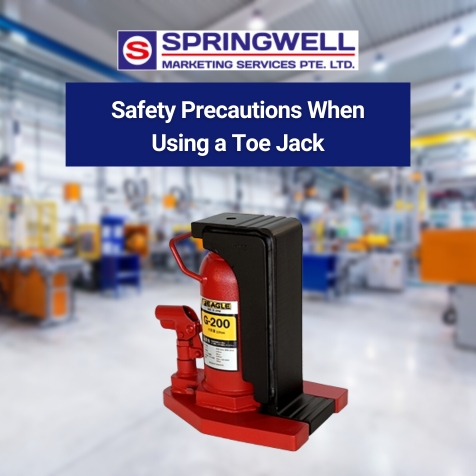
A toe jack is a device used to lift heavy loads, such as machines or vehicles. It consists of two vertically mounted posts and a horizontal platform which supports the load.
Toe jacks can be convenient when lifting heavy loads, but if used carelessly it can lead to serious injury. Therefore, it is important to take the necessary safety precautions when using a toe jack.
Essential Safety Precautions to Keep in Mind
Here are some safety precautions to follow when using a toe jack:
1) Inspect the Surroundings
Before lifting any load, make sure to inspect the surrounding area to ensure that there is enough clearance for the jack and the load.
Make sure there are no obstacles or other hazards that could interfere with the lift.
2) Position the Jack Correctly
Place the jack on a level surface that is capable of supporting the weight of the load.
Ensure that it is properly aligned with the centre of gravity of the object you are lifting and that it is positioned securely before beginning to lift.
3) Securely Attach Loads
Once the jack is in place, make sure to securely attach the load by using appropriate straps or chains. This will prevent any shifting or slipping of the load which can lead to an accident.
4) Wear Protective Gear
It is important to wear protective gear, including eye protection, gloves, and steel-toe boots when using a toe jack to lift a heavy load. This will help prevent injuries in case something goes awry during the lift.
5) Use Care When Lifting
When lifting, use slow and steady movements to prevent potential accidents. Take the time to correctly adjust the jack before beginning the lift, and make sure that it is properly secured.
Sudden movements can lead to the loss of balance and potentially cause injury.
6) Know Your Capacity Limits
It is important to be aware of the lifting capacity of your toe jack. Do not exceed the maximum weight limit that is recommended for your specific model.
Overloading the jack may cause harm to either the user or the equipment being lifted.
Takeaway
It is essential to take the necessary safety precautions when using a toe jack. Always inspect your surroundings, position the jack correctly, secure loads firmly, wear protective gear, use caution when lifting, and know your capacity limits.
Following these guidelines will help ensure that you use a toe jack safely and prevent any injuries or damage to property.