Is your industrial ladder actually a S$20,000 fine waiting to happen during your next MOM spot check?
Most safety managers in Singapore know that household-grade stools don’t belong on a factory floor. The real challenge is understanding the difference between “industrial-grade” equipment and a genuinely MOM-compliant solution.
As Workplace Safety and Health (WSH) enforcement becomes stricter, procurement decisions carry more responsibility than ever. Businesses are expected to ensure every ladder used on-site complies with Singapore’s latest safety standards, while reducing fall-from-height risks across daily operations.
Investing in a high-quality MOM-compliant platform ladder in Singapore helps protect workers, improve operational safety, and keep facilities audit-ready for the long term.
In this 2026 guide, we’ll walk through the key safety requirements, technical specifications, and procurement considerations businesses should know before purchasing industrial access equipment.
Key Takeaways
- Why Singapore’s WSH guidelines increasingly favour platform ladders over traditional A-frame ladders
- The essential technical specifications required for industrial compliance
- How to calculate proper working height to prevent overreaching
- What safety officers should look for during inspections and audits
- Common maintenance issues caused by Singapore’s humid industrial environment
Understanding MOM Compliance for Platform Ladders in Singapore
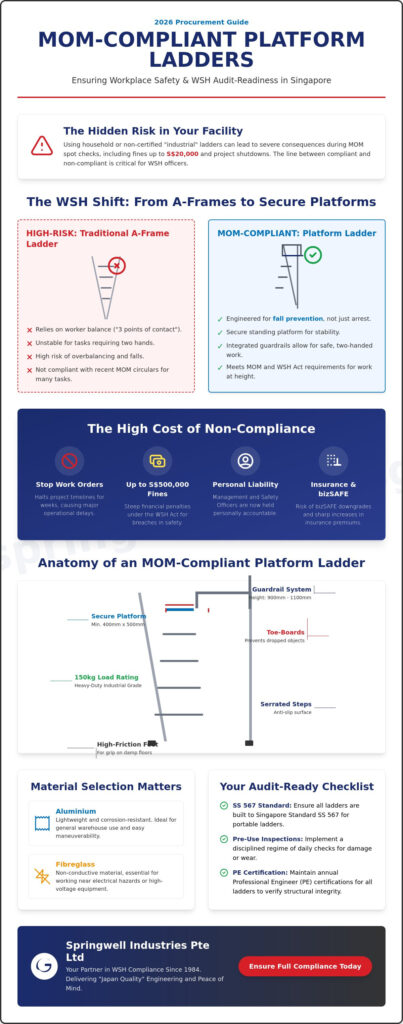
An MOM-compliant platform ladder in Singapore is more than a standard climbing tool. It is a purpose-built work-at-height solution designed to improve worker stability and reduce fall risks during industrial tasks.
Unlike traditional ladders, platform ladders provide:
- a stable standing platform,
- integrated guardrails,
- toe-board protection, and
- better support for prolonged work.
This allows workers to safely use both hands while performing maintenance, inspections, or warehouse operations, without relying purely on balance.
The Ministry of Manpower (MOM) increasingly prioritises these solutions because they reduce overreaching incidents and provide stronger fall prevention compared to conventional step ladders.
Why Procurement Standards Matter
Under the Workplace Safety and Health (WSH) Act, procurement teams have a legal responsibility to ensure workplace equipment complies with recognised safety standards.
For industrial ladders, this usually means compliance with:
- Singapore Standard SS 567,
- Work at Heights regulations, and
- relevant industrial load requirements.
These standards define critical areas such as structural integrity, load-bearing capacity, slip resistance, and platform safety.
It’s no longer enough to simply purchase a ladder marketed as “industrial.” Safety officers and facility managers are expected to verify whether the equipment is actually suitable for regulated workplace use.
The Impact of the 2018 MOM Circular
The 2018 MOM Circular significantly changed how many Singapore businesses approach work-at-height safety.
Previously, the “three points of contact” rule was considered sufficient for ladder work. However, industries increasingly recognised that workers performing tasks with tools often needed both hands free, making traditional ladders less practical and more dangerous.
As a result, there has been a stronger push toward platform ladders equipped with:
- secure standing areas,
- guardrails,
- toe-boards, and
- anti-slip protection.
This reflects a broader industry shift from “fall arrest” toward proactive “fall prevention.”
Consequences of Non-Compliance
Using uncertified or non-compliant ladders creates risks that go beyond equipment failure.
Companies may face:
- Stop Work Orders (SWOs),
- failed WSH audits,
- higher insurance premiums,
- bizSAFE downgrades,
- or financial penalties under the WSH Act.
In serious cases, fines can reach up to S$500,000.
Liability has also shifted in recent years. Management personnel and safety officers may now be held accountable for negligent procurement decisions involving unsafe workplace equipment.
Technical Specifications of a Compliant Platform Ladder
Not all industrial ladders meet modern compliance standards. Procurement teams should carefully evaluate technical specifications, rather than rely solely on appearance or price.
A compliant ladder should first meet the requirements of a heavy-duty industrial load rating. In most cases, this means supporting at least 150kg to safely accommodate:
- the worker,
- tools,
- equipment components, and
- repeated daily usage.
Lower-rated ladders may suffer from structural fatigue or instability over time, especially in demanding industrial environments.
Platform & Guardrail Requirements
The platform itself plays a major role in worker safety. A properly designed platform ladder should provide enough standing space for stable movement during extended tasks.
Key features typically include:
- a minimum platform size of 400mm x 500mm,
- guardrails between 900mm and 1100mm in height,
- toe-board protection, and
- slip-resistant surfaces.
These features help minimise overbalancing and reduce the likelihood of dropped objects on-site.
Anti-Slip Features for Singapore’s Environment
Singapore’s humid climate creates additional slip risks in warehouses, factories, and maintenance areas.
High-quality platform ladders often include:
- serrated steps,
- high-friction rubber feet,
- oil-resistant footing, and
- textured standing platforms.
These details become especially important in environments exposed to moisture, chemicals, or oily flooring.
Material Selection: Aluminium vs Fibreglass
Choosing the right ladder material depends heavily on the work environment.
Aluminium platform ladders are commonly preferred for warehouse and logistics operations because they are lightweight, durable, and easy to move around large facilities.
Fibreglass ladders, on the other hand, are essential for electrical or high-voltage environments due to their non-conductive properties.
For facilities involved in M&E maintenance, electrical servicing or live circuit work, fibreglass is often considered a mandatory safety requirement, rather than an optional upgrade.
Stability & Anti-Tip Mechanisms
Stability remains one of the most important safety considerations for work-at-height equipment.
Higher-quality platform ladders may include:
- outriggers,
- reinforced locking systems,
- spring-loaded castors, or
- wider base frames.
These features improve stability by reducing the risk of:
- lateral tipping,
- accidental shifting,
- or movement during use.
For taller ladders, especially, anti-tip mechanisms are critical in maintaining worker confidence and reducing workplace incidents.
How to Choose the Right Ladder for Your Facility
Selecting the correct MOM-compliant platform ladder in Singapore involves more than measuring ceiling height.
A proper assessment should account for:
- working height,
- frequency of use,
- facility layout,
- task type,
- and environmental conditions.
a) Calculate Working Height Properly
One common mistake is purchasing ladders based purely on maximum reach height.
Instead, businesses should calculate platform height by subtracting roughly 2 metres from the total working height required. This helps prevent dangerous overreaching behaviour, which remains a common cause of workplace falls.
b) Match the Ladder to Usage Frequency
Ladders used repeatedly throughout the day should have a heavy-duty industrial frame capable of handling constant usage.
For example:
- warehouse picking operations,
- routine maintenance,
- and production floor inspections
These typically require more robust equipment than occasional access work.
Facilities with limited storage space may also benefit from foldable platform ladder designs that reduce storage footprint without compromising safety.
c) Platform Ladders vs Traditional Step Ladders
Many safety officers in Singapore now restrict prolonged use of traditional A-frame ladders for industrial tasks.
Current WSH recommendations generally favour platform ladders when:
- work exceeds 15–30 minutes,
- tasks require both hands,
- or workers operate above 2 metres.
The added stability helps reduce worker fatigue, while improving task efficiency and safety outcomes.
Although platform ladders involve a higher upfront investment, industrial-grade models often last significantly longer than cheaper alternatives, resulting in lower long-term replacement costs.
Inspection & Maintenance: Staying Audit-Ready
Maintaining an MOM-compliant ladder is not just about compliance — it’s a core part of workplace safety management.
Businesses should establish a regular inspection process that includes:
- pre-use checks,
- scheduled maintenance,
- annual inspections,
- and proper documentation.
Even a quick visual inspection before each shift can help identify serious safety risks early.
Common Wear & Tear in Singapore’s Climate
Singapore’s humidity accelerates wear on industrial equipment, especially in high-use environments.
Common issues include:
- rivet corrosion,
- joint fatigue,
- hardened rubber feet,
- worn anti-slip surfaces,
- and frame instability.
Ladders exposed to chemical residue or outdoor environments may deteriorate even faster if not properly maintained.
To extend lifespan:
- clean ladders regularly,
- store them in dry shaded areas,
- and replace worn components proactively.
Immediate Red Flags to Watch For
Any ladder showing the following issues should be removed immediately from service:
- bent side rails,
- cracked welds,
- missing rivets,
- loose fasteners,
- wobbling during use,
- or damaged anti-slip surfaces.
Unsafe equipment should always be clearly tagged as:
“Out of Service”
until repaired or replaced.
Springwell Industries: Your Partner in WSH Compliance
Springwell Industries has supported Singapore’s industrial sector since 1984, providing businesses with heavy-duty access equipment designed for demanding workplace environments.
With decades of experience in industrial safety solutions, the company understands the operational challenges faced by:
- warehouses,
- logistics hubs,
- manufacturing plants,
- and maintenance facilities.
Beyond supplying equipment, Springwell also provides guidance on:
- platform ladder selection,
- MOM compliance requirements,
- PE inspections,
- and long-term maintenance planning.
This helps businesses build safer workplaces while staying prepared for future WSH enforcement standards.
Future-Proof Your Workplace Safety Strategy
Workplace safety expectations continue to evolve, especially in industries that involve frequent work at height.
Choosing a reliable MOM-compliant platform ladder in Singapore is not simply about passing inspections. It’s an investment in:
- worker protection,
- operational continuity,
- and long-term compliance.
Businesses that prioritise certified, industrial-grade equipment today are far better positioned to reduce liability risks and maintain safer operations in the years ahead.
Frequently Asked Questions
1) What makes a platform ladder MOM compliant in Singapore?
To qualify as an MOM-compliant platform ladder in Singapore, the equipment must typically comply with SS 567:2020 standards for structural integrity and workplace safety.
A compliant platform ladder should include:
- a secure standing platform,
- integrated guardrails,
- toe-board protection,
- and a clearly labelled industrial load rating.
These features help reduce fall risks and improve worker stability during industrial tasks.
2) Is it mandatory to use platform ladders instead of A-frame ladders?
A-frame ladders are not completely banned, but WSH guidelines increasingly prioritise platform ladders for longer-duration or higher-risk tasks.
Platform ladders are generally recommended when:
- work exceeds 15–30 minutes,
- both hands are required,
- or workers operate above 2 metres.
Their larger standing platform and guardrail protection help reduce overreaching and worker fatigue.
3) How often should industrial ladders be inspected?
Industrial ladders should undergo:
- routine pre-use visual checks,
- scheduled maintenance inspections,
- and annual inspections by a competent person.
For heavy-duty industrial environments, Professional Engineer (PE) load testing may also be required to ensure structural integrity and ongoing compliance.
4) Can household ladders be used in warehouses?
No. Household ladders are generally not designed for industrial environments and may not meet Singapore’s workplace safety standards.
Industrial sites typically require ladders certified to:
- SS 567, or
- EN131 Professional standards
with sufficient industrial load capacity.
Using uncertified equipment may expose businesses to compliance violations and workplace safety risks.
5) What is the maximum height allowed for a platform ladder in Singapore?
Mobile platform ladders commonly support working heights of up to around 4 metres.
Beyond that height, businesses may need to consider:
- mobile scaffold towers,
- elevated work platforms,
- or other specialised access systems
depending on site conditions and WSH requirements.
6) Do platform ladders require toe-boards?
Toe-boards are typically required when there is a risk of tools or materials falling from height.
They help prevent objects from slipping off the platform and improve compliance with Work at Heights safety requirements.
7) What is SS 567 and why is it important?
SS 567 is the Singapore Standard governing the design, testing, and safety requirements of portable ladders.
It serves as a key benchmark during:
- MOM inspections,
- workplace audits,
- and procurement evaluations.
Using equipment that complies with SS 567 helps reduce operational risks and improve workplace safety standards.
8) Are fibreglass platform ladders better than aluminium ladders?
It depends on the application.
Fibreglass ladders are preferred for:
- electrical work,
- live circuit environments,
- and high-voltage applications
because they are non-conductive.
Aluminium ladders are generally preferred for:
- warehouses,
- logistics operations,
- and general industrial use
because they are lightweight and easier to maneuver.