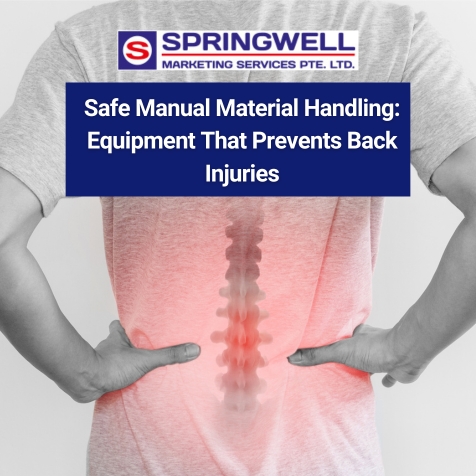
Back injuries remain one of the most common workplace hazards across industries — from warehouses and factories to retail stores and logistics hubs. Many of these injuries occur during manual material handling tasks, such as lifting, pushing, pulling, or carrying heavy loads.
While proper training and posture help reduce risks, the most effective prevention strategy lies in using the right material handling equipment.
Today, we will explore how to minimise back strain, the science behind common workplace injuries, and the essential tools every facility should consider for a safer, more ergonomic workflow.
The Hidden Cost of Back Injuries at Work
According to global occupational safety data, musculoskeletal disorders (MSDs) — especially those involving the lower back — account for a significant portion of workplace injuries. In Singapore, the Workplace Safety and Health (WSH) reports show that manual handling remains a leading cause of minor and major injuries in logistics and manufacturing sectors.
The impact goes beyond physical pain:
- Reduced productivity: Injured workers require longer recovery time, affecting shift efficiency.
- Higher absenteeism and compensation costs: Employers face higher insurance premiums and lost output.
- Long-term strain: Even mild, repeated lifting can lead to chronic back conditions.
Addressing these issues starts with rethinking how materials are moved — not just who moves them.
Understanding the Risk Factors
Back injuries typically occur when a worker’s body is placed under excessive strain due to poor technique or repetitive effort.
Common risk factors include:
- Lifting loads that are too heavy or bulky.
- Twisting while carrying an object.
- Reaching too far or repeatedly bending.
- Inadequate rest or fatigue, reducing core stability.
The goal of safe material handling is not to remove manual work entirely, but to support it using ergonomic equipment designed to share or reduce the load.
How Equipment Reduces Back Strain
Material handling aids act as mechanical extensions of the human body. They reduce direct lifting and awkward posture by:
- Minimising bending and reaching through height-adjustable platforms.
- Transferring load stress from muscles to mechanical components.
- Improving stability with balanced lifting and lowering mechanisms.
- Enabling one-person operation, reducing coordination strain and fatigue.
Incorporating these tools allows employees to move heavy or repetitive loads safely and consistently, even in tight spaces.
Essential Equipment for Preventing Back Injuries
1. Pallet Jacks (Hand Pallet Trucks)
Ideal for: Warehouses, retail stockrooms, logistics facilities.
Pallet jacks are one of the simplest, yet most effective tools for preventing lifting injuries. By allowing workers to lift and move palletised goods without bending or carrying, they remove the need for direct manual strain.
Modern pallet jacks come in both manual and electric versions, offering height control and easy manoeuvrability — especially important in confined areas or long aisles.
2. Lift Tables and Scissor Lifts
Ideal for: Assembly lines, packaging zones, maintenance workshops.
Lift tables raise or lower loads to comfortable working heights. This reduces repetitive bending and allows employees to maintain neutral postures when handling parts or products.
Scissor lifts can be manual-hydraulic or electric, depending on load requirements. They’re especially valuable when items must be transferred between different heights or workstations.
3. Work Positioners
Ideal for: Light manufacturing, electronics assembly, printing facilities.
Work positioners are smaller, more mobile lifting aids that enable fine height adjustments for compact loads.
By positioning items at waist level, workers avoid stooping or overreaching. Many models feature rotating or tilting platforms, further enhancing ergonomic handling.
4. Stackers and Semi-Electric Stackers
Ideal for: Warehouses, distribution centres, and logistics hubs.
Manual or semi-electric stackers allow operators to lift heavy pallets or boxes vertically without strain. Unlike forklifts, they are compact, quiet, and easy to operate in small spaces, making them suitable for indoor use.
By reducing direct lifting and pushing effort, stackers protect the spine from compression-related injuries — one of the leading causes of long-term back pain.
5. Platform Trolleys and Service Carts
Ideal for: Retail, hospitality, healthcare, and general facility use.
Trolleys and carts reduce the need to manually carry items over long distances. When properly designed with ergonomic handles and swivel casters, they minimise pushing resistance and prevent twisting injuries.
Best practice tip: Choose trolleys with adjustable handle heights to fit different operators and keep the spine in alignment during movement.
6. Drum Lifters and Barrel Handling Equipment
Ideal for: Chemical plants, food production, and industrial warehouses.
Drums and barrels are among the most awkward loads to handle manually, due to their shape and weight distribution. Drum lifters allow safe clamping, tilting, and transporting without bending or rolling by hand — a major contributor to lower-back strain.
These tools improve safety while ensuring precise control during liquid transfers or storage.
7. Powered Material Lifts
Ideal for: Multi-level warehouses, mezzanine transfers, and maintenance applications.
Powered lifts reduce the need for workers to lift or carry items up stairs or platforms. They provide vertical movement for goods using electric motors or hydraulic systems, eliminating the repetitive strain associated with manual lifting.
This equipment is particularly valuable for reducing cumulative trauma from frequent vertical handling.
Implementing Safe Material Handling Practices
While equipment plays a central role, it must be complemented by sound workplace practices:
- Conduct risk assessments to identify manual handling hazards.
- Train employees on safe lifting techniques and proper equipment use.
- Plan workflows to reduce unnecessary lifting or carrying distances.
- Encourage early reporting of strain or discomfort to prevent chronic injuries.
- Maintain and inspect all handling equipment regularly to ensure reliability.
When both workers and employers share responsibility for safety, the risk of injury declines dramatically.
Aligning with WSH Regulations in Singapore
Under Singapore’s Workplace Safety and Health (Manual Handling) Guidelines, employers must assess lifting tasks and take reasonable measures to minimise risks. This includes mechanical aids when the load or frequency of lifting poses a potential hazard.
Investing in ergonomic tools and proper training not only meets compliance requirements but also promotes a culture of care — one that values worker health and long-term productivity.
Takeaway
Back injuries are not inevitable — they’re preventable. Through thoughtful workplace design and the right mix of lifting equipment, businesses can transform manual handling into a safe, efficient process.
Ergonomic tools like lift tables, stackers, and trolleys don’t just reduce injury risks; they improve workflow, morale, and performance. The safest workplaces are those that recognise human limits — and design systems to support them.