What if your most essential height access tool could shrink to just 25% of its deployed height, while still meeting the latest 2026 MOM safety standards?
That’s the challenge many facility managers and contractors face today.
As industrial units in Singapore become increasingly space-constrained, storing and transporting traditional ladders has become a growing operational headache. A fixed-frame ladder that reaches 3.8 metres may perform well on-site, but fitting it into a service van or compact workshop is another story entirely.
Today, we compare modern telescopic ladders against traditional access equipment to help businesses understand the trade-offs between portability, stability, setup speed, and MOM compliance.
We’ll also examine the safety standards, load-testing requirements, and practical considerations that matter most in real industrial environments.
Key Takeaways
- Telescopic ladders offer major space-saving advantages for service vans and compact storage areas.
- Traditional platform ladders still provide superior stability for prolonged industrial tasks.
- EN131-6 certification remains essential for industrial telescopic ladders in Singapore.
- Modern 2026 models feature improved locking systems and safer soft-close mechanisms.
Understanding the Telescopic Ladder
A telescopic ladder is a retractable access tool designed with overlapping sections that slide into one another. Unlike conventional ladders, it collapses into a compact form for easier storage and transportation.
For Singapore businesses operating in warehouses, service facilities, commercial buildings, or mobile maintenance environments, this compact design offers a major operational advantage.
Many contractors no longer have the luxury of storing large fixed-frame ladders, especially in crowded workshops or service vehicles where every square metre matters.
Most industrial telescopic ladders are available in either straight or A-frame configurations depending on the intended use. Modern 2026 models also place much greater emphasis on integrated safety systems, particularly the locking mechanism that ensures each rung remains securely engaged during use.
The Evolution of Retractable Ladder Technology
Material engineering has significantly improved telescopic ladder performance over the last decade. High-grade 6061-T6 aluminium alloys now allow manufacturers to reduce overall ladder weight while still maintaining the industrial load ratings required for MOM compliance.
Many premium models have also moved away from older manual locking systems in favour of soft-close retraction mechanisms. These systems help slow the ladder’s collapse speed, reducing the risk of finger injuries during storage and handling.
For industrial users, this translates into:
- safer daily operation,
- smoother deployment,
- and longer equipment lifespan.
Why More Singaporean Contractors Are Choosing Telescopic Ladders
For mobile contractors and facility maintenance teams, portability is a top priority. A telescopic ladder collapses to a compact size, easily fitting into:
- Passenger lifts
- Small utility rooms
- Standard service vans (no roof rack needed)
This makes them ideal for technicians who travel between multiple sites daily.
Their adjustable height is another major advantage. In spaces with different ceiling heights or limited overhead clearance, a single telescopic ladder can do the job of multiple fixed-length ladders.
Modern industrial models have also seen significant stability upgrades. Features like wide stabiliser bars, anti-slip rubber feet, and secure locking indicators give users more confidence on slippery floors compared to older retractable ladders.
Telescopic vs Traditional Ladders: The Professional Comparison
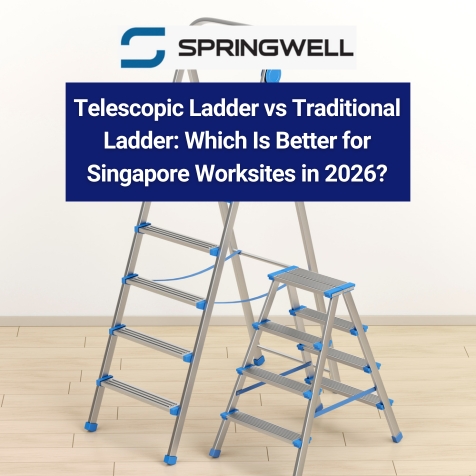
Choosing between a telescopic ladder and a traditional platform ladder involves more than just portability. Each option performs differently, depending on the type of work being carried out.
Telescopic ladders excel in short-duration tasks where mobility and storage efficiency matter most. They are ideal for:
- quick inspections,
- lighting adjustments,
- CCTV servicing,
- and general maintenance work requiring frequent movement.
Traditional platform ladders, however, still outperform telescopic designs in many heavy-duty industrial applications. Their wider standing platforms provide superior stability for tasks involving drilling, electrical servicing, or prolonged work at height.
Workers also experience less foot fatigue during longer tasks because the standing surface distributes weight more evenly than narrow ladder rungs. This is why many safety officers continue to prefer platform ladders for jobs exceeding 30 minutes or tasks requiring both hands.
Storage & Space Efficiency
Storage footprint remains one of the strongest arguments in favour of telescopic ladders.
A traditional fixed-frame ladder with a 10-foot reach may require more than 2.4 metres of vertical storage space. A telescopic ladder with similar reach capability can often retract to under 1 metre.
For Singapore businesses operating in compact warehouses, service vehicles, or high-density industrial units, this difference can significantly improve operational flexibility and transportation efficiency.
Safety Standards & Industrial Compliance in Singapore
Not all telescopic ladders are suitable for industrial use. Businesses should ensure their equipment complies with relevant workplace safety standards, particularly EN131-6 certification, which specifically applies to telescopic ladder designs.
This standard evaluates the structural stresses created by retractable mechanisms and ensures the ladder can safely support industrial working loads.
Critical Safety Features to Inspect
Before purchasing or deploying a telescopic ladder, operators should inspect:
- locking indicators,
- anti-slip rubber feet,
- stabiliser bars,
- hinge conditions,
- and industrial load labels.
Modern models now commonly include green/red locking indicators and reinforced anti-collapse protection systems to reduce accidental deployment failures.
Regular inspections are equally important, especially in high-use industrial environments where wear and tear may affect locking performance over time.
Choosing the Right Ladder for Your Worksite
The best ladder depends entirely on how the equipment will be used day to day.
Businesses prioritising portability, compact storage, and frequent transportation will often benefit more from telescopic ladders. They are especially useful for mobile maintenance teams and short-duration access tasks.
However, businesses performing prolonged industrial work at height may still find platform ladders to be the safer and more practical option. Their enhanced stability and larger working platforms make them better suited for demanding operational environments.
In reality, many facilities benefit from maintaining both ladder types for different operational requirements rather than relying exclusively on one solution.
Securing Your Industrial Advantage for 2026
Modern industrial worksites demand equipment that balances portability, durability, compliance, and worker safety.
A high-quality telescopic ladder offers clear advantages for Singapore’s increasingly compact and mobile work environments. However, traditional platform ladders continue to play an essential role in heavy-duty industrial applications, where stability remains the top priority.
Since 1984, Springwell Industries has supported local businesses with industrial access solutions designed around long-term reliability and workplace safety.
By selecting properly certified equipment and maintaining strict inspection standards, businesses can improve operational efficiency while staying fully compliant with evolving WSH requirements.
Frequently Asked Questions
Are telescopic ladders legal for industrial use in Singapore?
Yes, provided the ladder complies with relevant safety standards, such as EN131-6 and Singapore’s Workplace Safety and Health regulations.
What is the maximum weight capacity of a professional telescopic ladder?
Most industrial-grade telescopic ladders support up to 150kg, including the worker and carried tools.
How often should ladders be inspected?
Ladders should undergo daily visual checks alongside scheduled maintenance inspections to ensure they remain safe for industrial use.
Can telescopic ladders be used on uneven ground?
Only models designed with levelling systems or stabilising features should be used on uneven surfaces. Standard models generally require a flat, stable base during operation.