Choosing the right aerial work platform can make the difference between a smooth, efficient project and costly delays. While both scissor lifts and boom lifts help workers reach elevated areas safely, each serves distinct purposes depending on your specific indoor requirements.
Understanding when to deploy each type of lift will help you maximise productivity, ensure worker safety, and avoid unnecessary equipment costs.
Today, we will break down the key differences between scissor lifts and boom lifts for indoor applications, helping you make informed decisions for your next project.
What Are Scissor Lifts and Boom Lifts?
Before diving into specific applications, let’s clarify what sets these two machines apart.
Scissor Lifts
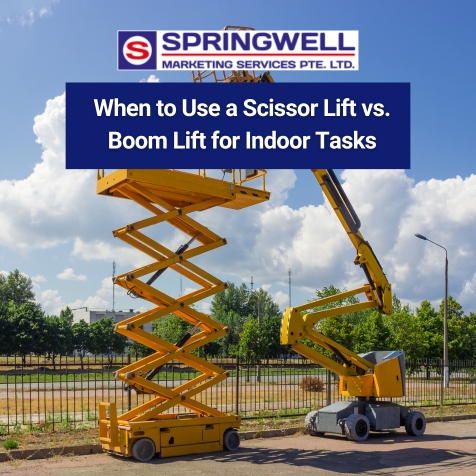
Scissor lifts use a crisscrossing metal support system that extends vertically, much like an accordion. They provide a stable platform that moves straight up and down, offering excellent weight capacity and a spacious work area.
Most scissor lifts designed for indoor use are electric-powered, making them ideal for enclosed spaces.
Boom Lifts
Boom lifts, also called cherry pickers or bucket trucks, feature an articulating arm that can extend both vertically and horizontally.
This arm typically ends in a small basket or platform. Boom lifts excel at reaching over obstacles and accessing hard-to-reach areas that require precise positioning.
Key Factors to Consider for Indoor Work
Several factors should influence your decision when selecting aerial equipment for indoor tasks:
Ceiling Height and Space Constraints
Indoor environments often present unique spatial challenges. Low ceilings, narrow corridors, and tight corners can limit your equipment options.
Scissor lifts typically require more vertical clearance due to their folding mechanism, while boom lifts may need additional space for their extending arms.
Floor Conditions
Indoor floors vary significantly, from polished concrete warehouses to delicate finished surfaces in retail spaces.
Equipment weight distribution and tire types become crucial considerations to prevent floor damage.
Power Requirements
Indoor work typically demands electric equipment to avoid exhaust fumes and reduce noise levels. Both scissor lifts and boom lifts offer electric variants, but their runtime and charging requirements differ.
Precision and Reach Requirements
Some tasks require pinpoint accuracy, while others need broad coverage areas. The nature of your work will heavily influence which lift type serves you best.
When to Choose Scissor Lifts for Indoor Tasks
Scissor lifts shine in specific indoor scenarios where stability and platform space take priority.
Large Platform Work Areas
When your project requires multiple workers, extensive tools, or bulky materials at height, scissor lifts provide unmatched platform space.
Their rectangular work areas typically range from 6 to 8 feet in length, accommodating several team members comfortably.
Warehouse Maintenance and Inventory Management
Large warehouses benefit from scissor lifts’ ability to handle heavy loads while providing stable work platforms.
Whether you’re installing overhead lighting, conducting HVAC maintenance, or managing high-bay storage, scissor lifts offer the stability and capacity needed for these demanding tasks.
Ceiling Installation Projects
Installing drop ceilings, light fixtures, or sprinkler systems often requires workers to move systematically across large areas.
Scissor lifts allow teams to position themselves directly beneath work areas and make incremental adjustments as they progress.
Heavy Load Capacity Needs
Scissor lifts typically support 225 to 1135 kilograms, significantly more than most boom lifts.
When your indoor project involves heavy materials, multiple workers, or substantial tool requirements, scissor lifts provide the necessary weight capacity.
When to Choose Boom Lifts for Indoor Tasks
Boom lifts excel when precision, reach, and obstacle navigation become primary concerns.
Accessing Hard-to-Reach Areas
Indoor spaces often contain obstacles like machinery, shelving units, or architectural features that block direct vertical access.
Boom lifts can extend up and over these obstructions, reaching areas that would be impossible for scissor lifts to access.
Detailed Maintenance Work
Tasks requiring precise positioning, such as electrical repairs, detailed painting, or equipment servicing, benefit from boom lifts’ ability to position workers exactly where needed. The articulating arm allows for fine adjustments that scissor lifts cannot match.
Working Around Obstacles
Manufacturing facilities, retail spaces, and office buildings often contain permanent fixtures that cannot be moved. Boom lifts can navigate around these obstacles, extending over conveyor systems, around columns, or through tight spaces.
High-Precision Applications
When your work requires reaching specific points rather than covering broad areas, boom lifts provide superior positioning control.
This makes them ideal for tasks like installing signage, performing detailed inspections, or accessing specific equipment components.
Safety Considerations for Indoor Use
Both lift types require specific safety protocols for indoor applications.
Electrical Safety
Indoor environments often contain electrical hazards that outdoor work doesn’t present.
Ensure your chosen equipment maintains appropriate clearances from power lines, electrical panels, and other energised components. Many indoor boom lifts feature insulated booms for electrical work.
Floor Protection
Protecting interior flooring requires careful equipment selection. Look for lifts with non-marking tires and appropriate weight distribution to prevent damage to finished surfaces.
Some facilities may require protective mats or specialised tyre compounds.
Overhead Clearance
Calculate total height requirements carefully, including the lift’s stowed height plus any items workers will carry.
Sprinkler systems, light fixtures, and ceiling-mounted equipment can create unexpected clearance issues.
Cost Considerations
Budget often plays a decisive role in equipment selection.
Rental vs. Purchase Costs
Scissor lifts generally cost less to rent or purchase than boom lifts with comparable height capabilities.
However, boom lifts may complete certain tasks more efficiently, potentially offsetting higher equipment costs through reduced labour time.
Operational Efficiency
Consider how each lift type affects project timelines.
Scissor lifts may require more setup and repositioning for complex tasks, while boom lifts might complete the same work with fewer moves but at a slower pace due to their smaller platforms.
Takeaway
Your decision should align with your specific project requirements, budget constraints, and safety considerations.
For projects requiring stable platforms, heavy lifting capacity, and systematic coverage of large areas, scissor lifts typically provide the best solution. They excel in warehouse environments, large-scale installations, and situations where multiple workers need to collaborate at height.
Boom lifts serve projects best when precision, obstacle navigation, and targeted access take priority. They’re ideal for maintenance work, detailed installations, and accessing specific points in complex indoor environments.
Springwell for Material Handling Equipment
Springwell offers reliable, durable, and innovative material handling solutions to meet your every need. From scissor lifts and pallet trucks to trailer jacks and jib cranes, we provide top-quality equipment designed to improve efficiency and safety in your operations.
Whether you’re optimising a warehouse or managing heavy loads, Springwell is your trusted partner for seamless material handling. Discover our full range of products and let us help you streamline your workflow today!