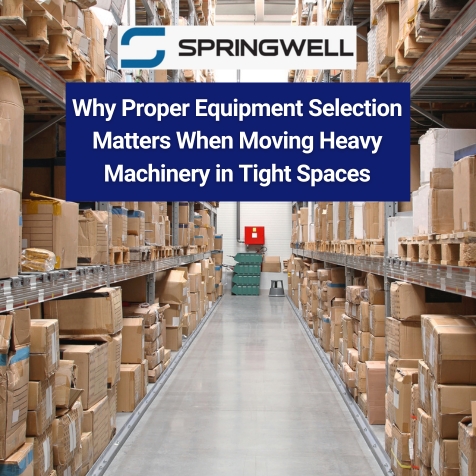
Moving heavy machinery is rarely straightforward. The challenge becomes even greater when the available space is limited.
Whether you’re operating in a warehouse, factory, workshop, or production facility, tight aisles, narrow access routes, and restricted work areas can significantly increase the risk of accidents, equipment damage, and operational delays.
While many businesses focus on the weight of the machinery being moved, the choice of material handling equipment is often equally important. Using the wrong equipment can create unnecessary risks, especially when manoeuvring large loads through confined environments.
Today, we’ll explore why equipment selection plays a critical role in safe machinery movement, and how choosing the right solution can improve both safety and efficiency.
The Challenges of Moving Machinery in Limited Space
Industrial facilities are becoming increasingly space-conscious.
As businesses maximise storage capacity and production areas, working spaces often become tighter and more congested. This creates several challenges when moving heavy equipment:
- Limited turning radius
- Narrow aisles and walkways
- Restricted access points
- Obstructed sight lines
- Increased risk of collisions
- Reduced room for error
In these environments, larger equipment is not always the most effective solution.
A machine that can easily handle the load may still struggle to navigate the available space safely.
This is why selecting equipment based on both load capacity and operating environment is essential.
Why Bigger Equipment Isn’t Always Better
Many people assume that larger lifting equipment automatically provides a safer solution for heavy loads.
In reality, oversized equipment can create additional challenges in confined areas.
For example, forklifts require sufficient space for turning, positioning, and reversing. In tight environments, operators may face difficulty manoeuvring around corners, shelving systems, machinery, or production lines.
Using equipment that is too large for the available workspace can lead to:
- Increased collision risks
- Damage to machinery and infrastructure
- Reduced visibility
- Longer handling times
- Higher operational stress for operators
The goal is not simply to move the load, but to move it safely and efficiently.
Matching Equipment to the Task
Different material handling equipment serves different purposes.
Selecting the most suitable option often depends on factors such as:
- Machinery dimensions
- Total load weight
- Travel distance
- Floor conditions
- Available operating space
- Required lifting height
For confined environments, businesses often benefit from equipment designed for manoeuvrability, rather than maximum lifting capacity.
Common solutions include:
Hand Pallet Trucks
Hand pallet trucks provide excellent manoeuvrability for transporting palletised loads over short distances.
Their compact footprint allows operators to work effectively in narrow aisles where larger powered equipment may struggle.
Industrial Stackers
Stackers offer lifting capability while maintaining a smaller footprint than conventional forklifts.
They are particularly useful when machinery or materials need to be positioned at elevated heights within restricted spaces.
Lift Tables
Lift tables help operators raise and position heavy components safely during assembly, maintenance, or relocation projects.
By bringing loads to the correct working height, they also reduce manual handling risks.
Work Positioners
Work positioners allow precise adjustment and placement of heavy items, improving control when working in crowded or space-constrained environments.
Safety Considerations Before Moving Machinery
Before any machinery relocation begins, proper planning is essential.
A site assessment should include:
Route Planning
Identify:
- Narrow passages
- Doorways
- Turning points
- Floor obstructions
- Overhead clearances
Understanding the full route helps prevent unexpected challenges during the move.
Load Assessment
The machinery’s:
- Weight
- Dimensions
- Centre of gravity
should be evaluated before selecting handling equipment.
Loads with uneven weight distribution may require additional precautions to maintain stability throughout the move.
Floor Conditions
Floor integrity plays a major role in safe machinery handling.
Operators should assess:
- Floor load capacity
- Surface condition
- Slopes and gradients
- Expansion joints
- Wet or slippery areas
Even small floor irregularities can affect equipment performance when handling heavy loads.
The Importance of Operator Control
In tight spaces, precision is often more important than speed.
Equipment that allows better control can significantly reduce the risk of accidents.
Manual and pedestrian-operated equipment often provides greater visibility and positioning accuracy when compared to larger ride-on machines operating in confined environments.
When visibility is limited, businesses should also consider using spotters to guide movements and monitor clearances.
Clear communication between operators and spotters helps prevent collisions and improves overall safety.
Reducing Risk Through Proper Equipment Selection
Every machinery move carries some level of risk.
However, many incidents occur because the selected equipment is not suitable for the environment rather than the load itself.
Choosing the correct material handling equipment can help:
- Improve manoeuvrability
- Reduce damage to equipment and facilities
- Enhance operator safety
- Increase productivity
- Minimise downtime
- Improve workflow efficiency
By focusing on the specific demands of the workspace, businesses can achieve safer and more reliable machinery handling operations.
Final Thoughts
When moving heavy machinery in confined spaces, success depends on more than lifting capacity alone.
Factors such as manoeuvrability, visibility, stability, and operator control all play a crucial role in ensuring a safe and efficient move.
Rather than relying on the largest equipment available, businesses should focus on selecting material handling solutions that are suited to both the load and the working environment.
With proper planning and the right equipment, even challenging machinery relocation tasks can be completed safely, efficiently, and with minimal disruption to operations.
Find the Right Material Handling Equipment for Your Facility
At Springwell, we provide a wide range of material handling equipment designed to support safe and efficient operations across warehouses, factories, workshops, and industrial facilities.
From hand pallet trucks and stackers to lift tables and specialised lifting solutions, our team can help you identify equipment that matches your operational requirements and workspace constraints.
Contact Springwell today to explore practical solutions for safer and more efficient machinery handling.